

If you are reading this, you may already know the exhausting reality of living without boundaries. Maybe you say "yes" when you mean "no" – and then feel resentful afterward. Maybe you have a friend, family member, or colleague who consistently takes advantage of your time and energy. Maybe you have tried to set a limit, only to be met with guilt, anger, or dismissal. Maybe you have convinced yourself that setting boundaries is selfish, or that people will reject you if you say no.
Here is the truth that people‑pleasing culture tries to hide from you: boundaries are not selfish. They are essential.
Setting healthy boundaries is one of the most important skills for mental health, emotional wellbeing, and fulfilling relationships. Boundaries are the limits we set for ourselves and communicate to others about what is acceptable and what is not. They protect our energy, our time, and our sense of self. They allow us to show up as our best selves in every area of life.
Without boundaries, we risk burnout, resentment, and losing ourselves in the service of others. With boundaries, we build relationships that are respectful, nurturing, and sustainable.
Greene Psychology Group in Raleigh, NC, offers evidence‑based therapy for boundary setting, using Cognitive Behavioral Therapy (CBT), assertiveness training, and interpersonal therapy. This guide is a complete, research‑backed resource: what boundaries are, why they matter, the different types of boundaries, how to set them, and how to find support.
Part 1: What Are Boundaries – A Clear Definition
Boundaries are the physical, emotional, and mental limits we establish to protect ourselves from being manipulated, used, or violated by others. They are the lines we draw that define where we end and others begin.
Boundaries Are Not Walls
There is a common misconception that boundaries are walls – rigid barriers that keep people out. But healthy boundaries are more like fences with gates. They protect what is inside, but they also allow for connection when it is safe and desired.
| Healthy Boundaries | Rigid Boundaries (Walls) | Enmeshed Boundaries (No Boundaries) |
|---|---|---|
| Flexible but clear | Inflexible, isolating | Nonexistent, confusing |
| Allow connection when safe | Keep everyone out | Let everyone in |
| Respect others' autonomy | Control others | Lose yourself in others |
| Communicate needs | Withhold needs | Ignore your own needs |
The Three Components of Boundaries
1. Awareness: Knowing what you need, what you value, and what you will and will not accept
2. Communication: Expressing your boundaries clearly and directly to others
3. Enforcement: Following through when your boundaries are violated
All three are necessary. Without awareness, you cannot set boundaries. Without communication, others cannot respect them. Without enforcement, boundaries are meaningless.
Part 2: The Mental Health Benefits of Setting Healthy Boundaries
Research consistently shows that setting healthy boundaries is crucial for mental health and wellbeing.
Reduced Stress and Burnout
When you have clear boundaries, you protect your energy and prevent overwhelm. Boundaries help you manage stress by defining what you can and cannot take on. Without boundaries, you may find yourself constantly overextended, leading to exhaustion and burnout.
The research: A 2024 study in Occupational Health Science found that boundary management strategies are essential for preventing emotional exhaustion and maintaining work‑life balance.
Improved Self‑Esteem
Boundaries are an expression of self‑respect. When you set and enforce boundaries, you send a message to yourself and others that your needs matter. Research has found a significant relationship between mental boundaries and self‑esteem. Personal boundaries are foundational to psychological well‑being, influencing emotional regulation, self‑esteem, and interpersonal relationships.
Healthier Relationships
Boundaries foster respectful, nurturing relationships rather than draining ones. They allow you to be authentic in relationships, rather than playing a role or sacrificing yourself. When you have clear boundaries, others know what to expect, reducing conflict and resentment.
Greater Sense of Control
Boundaries help you feel more in control of your life. Instead of reacting to others' demands, you can make intentional choices about how you spend your time and energy.
Prevention of Burnout in Helping Roles
For those in caregiving or helping professions – therapists, nurses, social workers, teachers – boundaries are essential for preventing burnout and maintaining the quality of care.
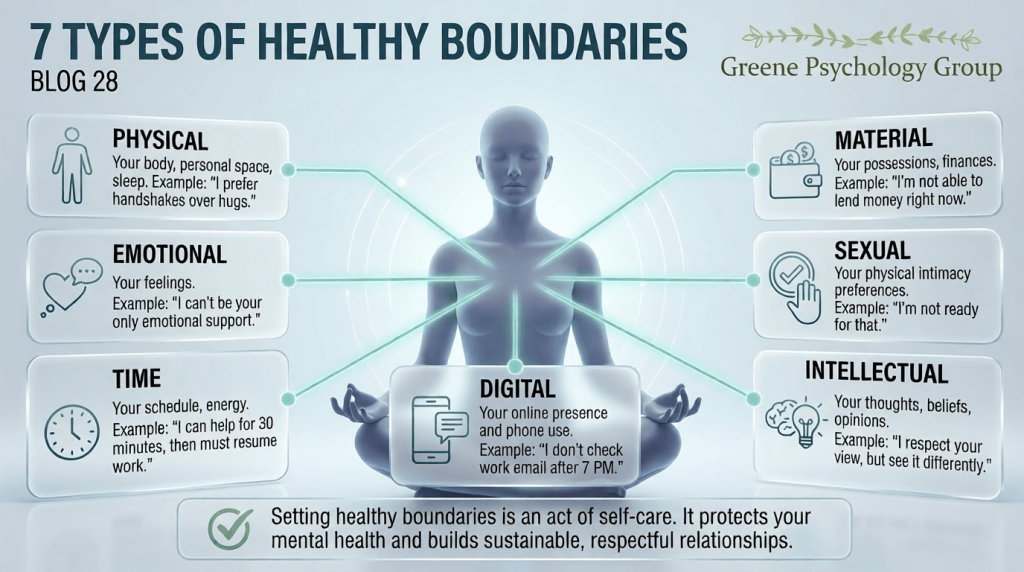
Part 3: Types of Boundaries – Knowing What to Protect
Boundaries apply to many different areas of life. Understanding the different types helps you identify where your boundaries may be weak.
1. Physical Boundaries
Physical boundaries protect your body and personal space.
Examples: Your personal space, physical touch, privacy, sleep, and rest
Healthy boundary: "I don't feel comfortable with hugs. I prefer a handshake."
Unhealthy boundary: Allowing physical touch you are uncomfortable with to avoid offending someone
2. Emotional Boundaries
Emotional boundaries protect your feelings and emotional energy.
Examples: Not taking responsibility for others' emotions, not allowing others to dump their emotional problems on you
Healthy boundary: "I can see you are upset, but I cannot be your only support right now."
Unhealthy boundary: Feeling responsible for fixing everyone else's problems
3. Time Boundaries
Time boundaries protect your time and energy.
Examples: Setting limits on how much time you spend on work, socializing, or helping others
Healthy boundary: "I can help you for 30 minutes, but then I need to get back to my own work."
Unhealthy boundary: Always saying "yes" to requests, leaving no time for yourself
4. Material/Financial Boundaries
Material boundaries protect your possessions and financial resources.
Examples: Lending money, borrowing possessions, sharing resources
Healthy boundary: "I'm not able to lend money right now."
Unhealthy boundary: Giving money you cannot afford to lose
5. Sexual Boundaries
Sexual boundaries protect your sexual autonomy and comfort.
Examples: Consent, sexual activity preferences, comfort with physical intimacy
Healthy boundary: "I'm not ready for that level of intimacy yet."
Unhealthy boundary: Engaging in sexual activity you are not comfortable with
6. Intellectual Boundaries
Intellectual boundaries protect your thoughts, ideas, and beliefs.
Examples: Respecting others' opinions, not tolerating dismissiveness or condescension
Healthy boundary: "I respect your opinion, but I see it differently."
Unhealthy boundary: Allowing others to dismiss or ridicule your beliefs
7. Digital Boundaries
Digital boundaries protect your online presence and technology use.
Examples: Social media sharing, work emails outside of work hours, phone availability
Healthy boundary: "I don't check work emails after 7 PM."
Unhealthy boundary: Always being available to others via phone or text
Part 4: The Boundary Cycle – Why It's So Hard to Set Boundaries
Many people struggle with boundaries because they have never learned how to set them – or because they have been punished for trying.
The Cycle of Boundary Avoidance
You feel overwhelmed: Someone asks for your time, energy, or resources, and you feel stressed
You want to say no: Your intuition tells you to set a limit
You feel guilty: You worry about disappointing the other person or being seen as selfish
You say yes anyway: You override your own needs to avoid conflict or disapproval
You feel resentful: You are angry at yourself and at the other person
You withdraw: You pull away from the relationship, or you continue the cycle
Why Setting Boundaries Feels So Hard
Fear of rejection: "If I say no, they will leave me"
Fear of conflict: "If I set a boundary, they will get angry"
Guilt: "I should be able to help. Saying no is selfish"
Low self‑esteem: "My needs don't matter as much as theirs"
Conditioning: You were raised to be a people‑pleaser or to sacrifice your needs for others
Cultural expectations: Some cultures discourage assertive communication
The Cost of Not Setting Boundaries
When you do not set boundaries, you pay a price:
Resentment: You become angry at the people you are trying to please
Burnout: You exhaust yourself trying to meet everyone's needs
Loss of identity: You lose touch with your own needs and desires
Unhealthy relationships: Others learn that they can take advantage of you
Anxiety and depression: The chronic stress of boundary violations takes a toll on your mental health
Part 5: How to Set Healthy Boundaries – A Step‑by‑Step Guide
Setting healthy boundaries is a skill that can be learned. Here is a step‑by‑step guide.
Step 1: Identify Your Limits
Before you can communicate a boundary, you need to know what it is.
Ask yourself: "What am I comfortable with? What am I not comfortable with?"
Identify your needs in different areas: physical, emotional, time, material, sexual, intellectual, digital
Pay attention to your feelings – resentment, exhaustion, or anxiety are often signs that a boundary has been violated
Questions to ask yourself:
"What drains my energy?"
"What makes me feel resentful?"
"What do I need more of in my life?"
"What do I need less of?"
Step 2: Challenge Unhelpful Beliefs
Many people struggle with boundaries because of unhelpful beliefs.
| Unhelpful Belief | More Balanced Alternative |
|---|---|
| "If I say no, they will reject me." | "If they reject me for setting a boundary, they were not a healthy person to have in my life." |
| "I should be able to help everyone." | "I can help some people, some of the time, but not everyone, all the time." |
| "Setting boundaries is selfish." | "Setting boundaries is self‑care. It allows me to be more present and generous when I choose to give." |
| "I don't deserve to have boundaries." | "Everyone deserves to have boundaries. My needs matter." |
Step 3: Start Small
If you are new to setting boundaries, start with low‑stakes situations.
Instead of: Confronting a difficult family member about a long‑standing issue
Try: Setting a boundary with a colleague about a small request
Examples:
"I can't take on that project right now. I have too much on my plate."
"I need to leave by 5 PM today. Can we finish this meeting by then?"
Step 4: Use Clear, Direct Communication
When communicating a boundary, be clear, direct, and specific.
Use "I" statements:
"I feel overwhelmed when I get calls after 9 PM. Can we keep calls to before that time?"
"I need to take a break from this conversation. Can we pick it up later?"
Avoid over‑apologizing and over‑explaining:
Instead of: "I'm so sorry, I really wish I could, but I just have so much going on, and I feel terrible..."
Try: "I can't help with that right now."
Step 5: Practice Saying No
Saying no is a skill. Practice it.
The "No" Script:
"Thank you for thinking of me, but I can't take that on."
"I appreciate you asking, but I need to say no to that."
"That doesn't work for me right now."
Remember: You are choosing between feeling guilty for a short time or resentful for a long time. Choose the short‑term discomfort.
Step 6: Be Consistent
Once you have set a boundary, stick to it. If you are inconsistent, others will learn that your boundaries are negotiable.
Step 7: Prepare for Pushback
Not everyone will respect your boundaries. Some people may get angry, guilt‑trip you, or try to manipulate you. Be prepared.
What to say when someone pushes back:
"I understand you're disappointed, but this is what I need right now."
"I'm not asking for your permission. I'm letting you know what I need."
"I hear that you're upset, and I'm still going to take the time I need."
Step 8: Start with Your Relationship with Yourself
The most important boundary is the one you set with yourself. That means:
Honoring your own needs
Not overcommitting
Taking care of your physical and emotional health
Saying no to behaviors that harm you
Part 6: Boundaries in Specific Relationships
Boundaries with Family
Family relationships can be the hardest place to set boundaries. You may have been raised with enmeshed boundaries, where family loyalty meant sacrificing your own needs.
Common challenges:
Parents who do not respect your adult autonomy
Siblings who take advantage of your generosity
In‑laws who overstep your boundaries
Strategies:
Be clear about what you will and will not tolerate
Set expectations early (e.g., holiday plans, financial boundaries)
Limit exposure if boundaries are consistently violated
Boundaries with Friends
Friendships should be mutual – not one‑sided.
Common challenges:
Friends who always take but never give
Friends who dump their emotional problems on you without reciprocity
Friends who make you feel guilty for setting limits
Strategies:
"I need to take a step back from this conversation. I'm feeling overwhelmed."
"I can't be your only support. I think you would benefit from talking to a professional."
"I need to focus on my own stuff right now. Can we catch up later?"
Boundaries at Work
Workplace boundaries are essential for preventing burnout.
Common challenges:
Emails and calls outside of work hours
Colleagues who dump their work on you
Managers who expect you to be always available
Strategies:
"I don't check emails after 7 PM. I'll respond tomorrow morning."
"I have a full plate right now. Can we talk about priorities?"
"I need to take my lunch break. I'll be back in 30 minutes."
Boundaries in Romantic Relationships
Healthy romantic relationships require clear boundaries.
Common challenges:
One partner sacrificing their needs for the other
Codependency – losing yourself in the relationship
Difficulty saying no to your partner
Strategies:
"I need some time alone right now. That's not a rejection of you."
"I love you, and I also need to take care of myself."
"I can't talk about this right now. Can we take a break and come back to it?"
Boundaries with Yourself
The most important boundaries are with yourself.
Examples:
Not checking work emails after a certain hour
Saying no to activities that drain you
Taking time for self‑care, even when you feel guilty
Not using substances to cope with stress
Honoring your sleep and rest needs
Part 7: How Therapy Can Help with Boundary Setting
If you struggle with boundaries, you are not alone. Many people need support to learn this skill.
Cognitive Behavioral Therapy (CBT)
CBT helps you identify and challenge the thoughts that keep you from setting boundaries.
Cognitive restructuring: "If I say no, they will reject me" becomes "If they reject me for setting a boundary, they were not a healthy person to have in my life."
Behavioral experiments: Testing out setting a boundary in a low‑stakes situation and seeing what happens
Assertiveness Training
Assertiveness is the ability to express your needs and boundaries clearly and respectfully. It is a skill that can be learned.
What assertiveness training includes:
Learning to say no without guilt
Using "I" statements
Setting limits calmly and clearly
Handling pushback
Interpersonal Therapy (IPT)
IPT focuses on improving the quality of your relationships. It helps you identify and change patterns that keep you stuck.
Mindfulness‑Based Therapy
Mindfulness helps you notice when your boundaries are being violated and regulate your emotional response.
At Greene Psychology Group, we offer CBT, mindfulness therapy, and individual therapy for boundary setting. We also offer family therapy to address boundary issues within family systems.
Part 8: Raleigh‑Specific Resources for Boundary Support
Crisis and Urgent Support
988 Suicide & Crisis Lifeline: Call or text 988 – 24/7, confidential
Alliance Health Mobile Crisis: (800) 510-9132 – 24/7, free
Community Programs
NAMI Wake County: Support groups for individuals and families
Raleigh Parks and Recreation: Classes and community events that can help build social connections
Outpatient Therapy (Greene Psychology Group)
We offer in‑person and online therapy for boundary setting, anxiety, depression, and relationship issues. We serve individuals, couples, and families. Contact us at (919) 205-5339.
Part 9: Putting It All Together – Three Boundary Archetypes
Archetype A: The People‑Pleaser
Presentation: 34‑year‑old, always says yes to everyone. Overcommitted, exhausted, resentful. Has not taken a vacation in years. Feels like she has lost herself.
Bottleneck: People‑pleasing with boundary difficulties.
Treatment map: 12 weeks of CBT + assertiveness training → Identify beliefs: "If I say no, people will reject me" → Practice assertive scripts: "I'm not able to take that on right now" → Tolerate others' discomfort → At 12 weeks, reports "I still feel uncomfortable saying no, but I do it anyway – and the world hasn't ended."
Archetype B: The Enmeshed Family Member
Presentation: 42‑year‑old, adult child of elderly parents. Feels responsible for everything – appointments, finances, emotional support. Has no time for own family. Resentful and exhausted.
Bottleneck: Enmeshment with no boundaries.
Treatment map: 12 weeks of CBT + family therapy → Identify beliefs: "I am responsible for my parents' happiness" → Set boundaries: "I can help with appointments, but I cannot manage all of their finances" → Practice enforcing boundaries → At 12 weeks, reports "I still feel guilty sometimes, but I have more balance."
Archetype C: The Overfunctioning Professional
Presentation: 38‑year‑old, high‑performing professional. Works 60‑hour weeks. Takes on everyone else's work. Never says no. Burned out and depressed.
Bottleneck: Workplace boundaries with burnout.
Treatment map: 12 weeks of CBT → Identify beliefs: "If I don't do it, it won't get done" → Set boundaries at work: "I have a full plate. Can we discuss priorities?" → Practice leaving work on time → At 12 weeks, reports "I still work hard, but I have boundaries now."
The information provided in this blog is for educational and informational purposes only and is not intended as medical advice, diagnosis, or treatment. It does not create a therapist‑patient relationship between you and Greene Psychology Group. Always seek the advice of a qualified mental health professional or physician with any questions you may have regarding a mental health condition. If you are in crisis or experiencing a medical emergency, please call 911 immediately or contact the 988 Suicide & Crisis Lifeline. For non‑emergency mental health support, call Greene Psychology Group at (919) 205-5339 or visit our website to schedule an appointment.
FAQs
Boundaries are the limits we set for ourselves and communicate to others about what is acceptable and what is not. They protect our energy, time, and sense of self, and they are essential for mental health and healthy relationships.
Signs include feeling resentful, exhausted, overwhelmed, or taken advantage of; saying yes when you mean no; feeling responsible for others' emotions; and avoiding conflict at all costs.
Common types include physical, emotional, time, material/financial, sexual, intellectual, and digital boundaries.
Setting boundaries can trigger fear of rejection, fear of conflict, guilt, low self‑esteem, and cultural conditioning that discourages assertiveness.
Start by identifying your limits, challenging unhelpful beliefs, starting with small boundaries, using clear "I" statements, and practicing saying no
Their reaction is not your responsibility. Stay calm, restate your boundary, and do not engage in arguments. If they consistently disrespect your boundaries, you may need to limit contact.
No. Setting boundaries is a form of self‑care. It allows you to show up more fully in your relationships because you are not depleted.
Yes. CBT, assertiveness training, and interpersonal therapy can help you identify unhelpful beliefs, learn communication skills, and practice boundary setting.
Healthy boundaries are flexible and allow for connection. Walls are rigid and keep everyone out. Healthy boundaries have gates; walls do not.
Be clear about what you will and will not tolerate, set expectations early, and be prepared for pushback. Family therapy can help with systemic boundary issues.
Set limits around your time (e.g., "I don't check emails after 7 PM"), communicate your capacity clearly, and practice saying no to additional responsibilities when you are overloaded.
Guilt is common, especially when you are new to setting boundaries. Remind yourself that boundaries are not selfish. The guilt will fade as you practice.
Sources
Setting healthy boundaries is not selfish – it is essential for your mental health and relationships. Evidence‑based therapy in Raleigh, NC, can help you learn to set boundaries, communicate assertively, and build relationships that respect your needs. Call Greene Psychology Group at (919) 205-5339 or schedule an appointment online. We offer individual therapy, couples counseling, family therapy, evening appointments, and free insurance verification. Same‑week availability for new clients.