
If you are reading this, you have probably watched your teenager struggle and felt helpless. Maybe they have stopped eating dinner with the family. Maybe they spend hours in their room, door closed, emerging only when necessary. Maybe their grades have slipped, or they have dropped out of activities they once loved. Maybe they have panic attacks before school, or they refuse to go at all. Maybe they are irritable, snapping at you over nothing, then retreating into silence.
As a parent, you are caught between two impossible questions: Is this normal adolescence, or is something really wrong? And if something is wrong: How do I help without pushing them away?
Here is the truth that no parenting book tells you: distinguishing normal adolescent moodiness from a treatable anxiety disorder is genuinely difficult – even for trained clinicians. The teenage brain undergoes massive rewiring. Hormones fluctuate. Social pressure intensifies. Some withdrawal and irritability are expected.
But there is a line. And crossing that line without intervention can have lifelong consequences. Anxiety disorders are the most common mental health condition in adolescents, affecting approximately 32% of teens at some point. Yet fewer than half receive treatment.
Greene Psychology Group offers evidence‑based therapy for teen anxiety in Raleigh, NC, using Cognitive Behavioral Therapy (CBT), Dialectical Behavior Therapy (DBT), and family‑involved care. This guide is a complete, research‑backed resource for parents: how to recognize the signs, how to talk to your teen about anxiety, what evidence‑based treatment looks like, and how to find the right help.
Part 1: Normal Adolescence vs. Anxiety Disorder – A Practical Framework
The single most common question we hear at Greene Psychology Group is: How do I know if this is just a phase, or if my teen actually needs help?
The answer lies not in any single behavior, but in three dimensions: duration, intensity, and impairment.
| Dimension | Normal Adolescence | Possible Anxiety Disorder (Seek Evaluation) |
|---|---|---|
| Duration | Worry or moodiness lasts hours or a couple of days. Usually resolves with sleep, distraction, or positive interaction. | Symptoms persist for more than two weeks without significant break. |
| Intensity | Nervousness before a test or social event is noticeable but does not prevent functioning. | Extreme reactions: panic attacks, meltdowns, refusal to attend school or social events. |
| Impairment | Still attending school, seeing friends (even if less frequently), maintaining basic hygiene and sleep. | Grades drop significantly. Withdrawal from all friends and activities. Refusing school. Major changes in eating or sleeping. |
The most important red flag: Any change in functioning that lasts more than two weeks. A previously B student who is now failing. A social teen who now has zero friends. An athlete who quits the team and stops exercising.
Research from Duke University's Center for Child and Family Policy found that parents who used this "duration, intensity, impairment" framework were three times more accurate in identifying when professional help was needed – and 60% less likely to seek unnecessary treatment for normal adolescent development.
Part 2: Common Anxiety Disorders in Teens – What to Look For
Before you can decide whether your teen needs therapy, it helps to know what you are looking for. These are the conditions we treat most often at Greene Psychology Group.
Generalized Anxiety Disorder (GAD)
What it looks like: Excessive worry about school, health, family, the future, or everyday events. The worry is difficult to control and is often accompanied by physical symptoms: headaches, stomachaches, muscle tension, fatigue.
What parents notice: Your teen asks for reassurance constantly ("Do you think I'll be okay?" "What if I fail?"). They may have trouble sleeping or concentrating.
Social Anxiety Disorder
What it looks like: Intense fear of being negatively evaluated in social situations. Teens with social anxiety may avoid parties, group projects, speaking in class, or even eating in the cafeteria.
What parents notice: Your teen makes excuses to avoid social events. They may be reluctant to order food at restaurants or talk on the phone. They may seem "shy" to an extreme degree.
Panic Disorder
What it looks like: Recurrent, unexpected panic attacks – sudden surges of intense fear with physical symptoms like racing heart, shortness of breath, dizziness, or feeling like they are "going crazy" or dying.
What parents notice: Your teen may avoid places where they fear a panic attack could occur (school, crowded places, driving). They may visit the school nurse frequently or complain of unexplained physical symptoms.
Separation Anxiety Disorder
What it looks like: Excessive fear or anxiety about being separated from attachment figures. This is common in younger children but can persist into adolescence.
What parents notice: Your teen may refuse to go to school, sleep away from home, or be away from you. They may have nightmares about separation or worry that something bad will happen to you.
Specific Phobias
What it looks like: Intense fear of a specific object or situation (e.g., needles, heights, animals, vomiting). The fear is out of proportion to the actual danger.
What parents notice: Your teen goes to great lengths to avoid the feared situation. They may have panic attacks when confronted with it.
Research from the National Institute of Mental Health (NIMH) shows that anxiety disorders are the most common mental health condition among adolescents, with a lifetime prevalence of approximately 32%. Early intervention is critical: untreated anxiety in adolescence is a strong predictor of adult anxiety disorders, depression, and substance use.
Part 3: The Anxiety Cycle in Teens – Why It Keeps Getting Worse
Anxiety in teens operates on a predictable cycle. Understanding this cycle is the first step to breaking free.
The Cycle
Trigger: Something activates anxiety – a test, a social event, a worry about the future, a physical sensation (racing heart).
Anxious Thought: The teen interprets the trigger as dangerous. "I'm going to fail." "Everyone will laugh at me." "Something bad is going to happen."
Physical Response: The body responds: racing heart, rapid breathing, muscle tension, stomach churning.
Avoidance or Safety Behaviors: The teen avoids the situation (skipping school, staying in their room) or uses "safety behaviors" (asking for reassurance, checking, having a parent nearby).
Temporary Relief: Avoidance provides short‑term relief – but the anxiety is reinforced. The next time the teen faces a similar trigger, the anxiety is stronger.
The Role of Avoidance
Avoidance is the engine that keeps anxiety going. Every time a teen avoids a feared situation, they teach their brain that the situation was truly dangerous – because they had to avoid it. They never learn that they could face it and survive.
How Parents Can Accidentally Reinforce Anxiety
It is natural to want to protect your child from distress. But when you accommodate anxiety – by letting them stay home from school, answering repeated reassurance questions, or doing things for them that they could do themselves – you are unintentionally reinforcing the anxiety.
Example:
Teen: "I can't go to school today. I feel sick."
Parent (accommodating): "Okay, stay home. I'll call the school."
Message to the brain: "School is dangerous. I was right to be afraid."
Alternative:
Parent (supportive but firm): "I know you're feeling anxious. Let's figure out how to get you there – even if it's just for one class."
Message to the brain: "Anxiety is uncomfortable, but I can handle it."
Part 4: How to Talk to Your Teen About Anxiety – Without Pushing Them Away
This is the most common question we hear from parents: My teen is clearly struggling, but they refuse to talk about it. How do I start the conversation?
What Does NOT Work
Accusation: "You have a problem and you need to see someone."
Minimizing: "It's not that bad. Just relax."
Comparison: "When I was your age, I didn't have this."
Ambush: Surprising them with a therapist without warning.
Lecturing: Long speeches about the importance of mental health.
What DOES Work
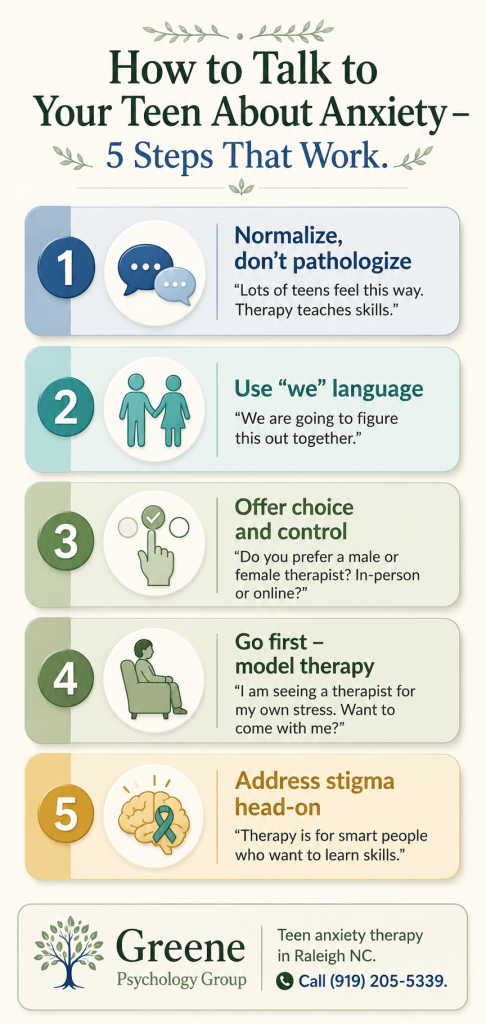
Step 1: Normalize, Don't Pathologize
Instead of: "You are so anxious all the time. It's not normal."
Try: "Lots of teens feel this way. Anxiety is your brain's alarm system – sometimes it goes off when there's no real danger. Therapy teaches skills to turn down the volume."
Step 2: Use "We" Language
Instead of: "You need help."
Try: "We are going to figure this out together. I want to understand what you are going through."
Step 3: Offer Choice and Control
Instead of: "You are going to therapy on Tuesday at 4 PM."
Try: "Would you prefer a therapist who is a man or a woman? Do you want to try in‑person or online? You can meet the therapist first and decide if they are a good fit."
Step 4: Go First (Model the Behavior)
Instead of: Sending them alone.
Try: "I have been feeling stressed too. I am going to see a therapist to work on my own stuff. Would you be willing to come with me for the first session? We can sit together."
Step 5: Address the Stigma Head‑On
Many teens refuse therapy because they fear being labeled "crazy" or "weak." Say: "Therapy is not for broken people. It is for smart people who want to learn skills. Every athlete has a coach. You are the athlete, and the therapist is your mental coach."
What If They Still Refuse?
If your teen is not in immediate danger (no suicidality, self‑harm, or psychosis), you have options:
Go to therapy yourself. A family therapist can teach you strategies to change the home environment, which often changes the teen's behavior.
Try school‑based counseling. Many Wake County public schools have mental health counselors. The lower barrier (it is "at school," not "a therapist's office") can reduce resistance.
Use a "warm handoff." Ask your pediatrician or a trusted adult (aunt, coach, clergy) to recommend therapy. Sometimes the message lands better from someone who is not a parent.
Part 5: What Evidence‑Based Therapy for Teen Anxiety Looks Like
If you are searching for therapy for teen anxiety in Raleigh, NC, you should know what quality care looks like. Not all therapy for teens is the same.
Cognitive Behavioral Therapy (CBT) – The Gold Standard
CBT is the most researched and effective treatment for adolescent anxiety. Guidelines from the National Institute for Health and Care Excellence (NICE) and the American Psychological Association recommend CBT as the first‑line treatment for anxiety disorders in children and adolescents.
How CBT works for teen anxiety:
1. Psychoeducation
Teens learn how anxiety works – the fight‑or‑flight response, the role of the amygdala, and why their body reacts the way it does. This alone reduces anxiety because the unknown is scarier than the known.
2. Cognitive Restructuring
Teens learn to identify anxious thoughts ("I'm going to fail this test") and challenge them with evidence. Over time, this changes the neural pathways that maintain anxiety.
3. Exposure Therapy
This is the active ingredient. Teens gradually and repeatedly face feared situations – starting with something that causes mild anxiety and working up to the scariest triggers – without using avoidance or safety behaviors. Over time, the anxiety decreases.
4. Relaxation and Mindfulness Skills
Teens learn breathing techniques, progressive muscle relaxation, and mindfulness practices to manage physical symptoms of anxiety.
Dialectical Behavior Therapy (DBT) for Teens
DBT is effective for teens who struggle with intense emotions, self‑harm, or suicidal behavior. DBT for adolescents (DBT‑A) includes:
Individual therapy
Multi‑family skills group (teens and parents learn together)
Skills: mindfulness, distress tolerance, emotion regulation, interpersonal effectiveness
24/7 phone coaching for crisis moments
Family‑Involved Care
Research shows that parent involvement significantly improves outcomes for teen anxiety. Family‑involved care may include:
Parent‑only sessions to learn how to reduce accommodation
Family sessions to improve communication
Skills practice at home with parent support
At Greene Psychology Group, we offer CBT for teen anxiety, family therapy, and online therapy.
Part 6: What a Therapy Session for Teen Anxiety Looks Like
If you are new to therapy for teen anxiety, you might wonder what happens in a session. Here is a typical structure.
Typical Individual Session (50 minutes)
| Time | Activity |
|---|---|
| 0–10 min | Check‑in: "How has your week been? Any anxiety? Any exposures you practiced?" |
| 10–30 min | Active work: Cognitive restructuring, exposure practice, or learning a new skill |
| 30–40 min | Processing: "What did you notice? What was the hardest part? What surprised you?" |
| 40–45 min | Planning: "What will you practice between now and next session?" |
| 45–50 min | Homework assignment: Specific, graded exposures or skills to practice at home |
Parent Involvement
In effective teen anxiety treatment, parents are usually involved in some way:
Parent check‑ins: Brief (5–10 minute) meetings with the therapist at the beginning or end of sessions
Parent‑only sessions: Occasional sessions to discuss how to reduce accommodation and support the teen's exposure practice
Family sessions: When family dynamics are contributing to the anxiety
What You Will NOT Experience
Forced sharing: The therapist will not force your teen to talk about anything they are not ready to discuss.
Judgment: The therapist understands that teen anxiety is not a choice.
Blame: The therapist will not blame parents for their teen's anxiety.
Surprise exposure: The therapist will never expose your teen to something without their knowledge and consent.
Part 7: The Role of Parents in Teen Anxiety Treatment
Many parents ask: Should I be involved? How much? Will my teen still talk to the therapist if I am there?
Level of Parent Involvement by Phase
Phase 1 – Intake and Assessment (First 1–3 sessions)
Parent role: High. You will meet with the therapist alone (or with your teen) to provide history, concerns, and context.
Phase 2 – Active Treatment (Ongoing, typically 12–20 weeks)
Parent role: Moderate. The therapist will meet with your teen alone for most of the session, then meet with you (alone or with teen) for 5–10 minutes to share observations, coordinate skills practice, and address concerns.
What you should NOT do: Demand to know everything your teen said. Therapists maintain confidentiality but will share safety concerns and broad themes.
Phase 3 – Crisis or Safety Concern
Parent role: Full involvement. The therapist is legally required to inform you if your teen discloses suicidal ideation with plan, self‑harm with injury, or intent to harm others.
Phase 4 – Termination and Relapse Prevention
Parent role: Collaborative. You and your teen (and therapist) create a written plan for what to do if symptoms return.
What Parents Should Never Do
Cancel therapy as punishment ("You are grounded, so no session this week.")
Use therapy content against your teen ("Your therapist said you need to control your anxiety, so stop worrying.")
Bribe your teen to attend ("I'll give you $50 if you go to therapy.") This undermines intrinsic motivation.
Research from Columbia University Department of Psychiatry found that parent involvement (specifically, attending parent check‑ins and practicing skills at home) improved teen outcomes by 40% compared to teen‑only therapy.
Part 8: Raleigh‑Specific Resources for Teen Anxiety
If your teen needs help urgently or you want additional support beyond therapy, these Wake County resources are available.
Crisis and Urgent Care
Alliance Health Mobile Crisis: (800) 510-9132 – 24/7, free, sends a crisis team to your home or school.
988 Suicide & Crisis Lifeline: Call or text 988 – teen‑friendly, confidential.
WakeMed Pediatric Psychiatric Emergency Department: 3000 New Bern Ave, Raleigh – for teens in immediate crisis (ages 5–17).
School‑Based Mental Health (Wake County Public Schools)
WCPSS Student Services: Each high school and middle school has a school psychologist, counselor, and social worker. Start with your school's student services office.
Mental Health Support Teams (MHST): Some WCPSS schools have embedded therapists from local agencies.
Outpatient Therapy (Greene Psychology Group)
We offer in‑person and online therapy for teens aged 14 and older. Parent check‑ins are standard. We accept most major insurance. Contact us at (919) 205-5339.
Part 9: Putting It All Together – Three Teen Anxiety Archetypes
Archetype A: The Anxious Overachiever
Presentation: 15‑year‑old, straight‑A student, suddenly having panic attacks before tests. Refuses to go to school on exam days. Complains of stomachaches.
Bottleneck: Performance anxiety with avoidance behavior.
Treatment map: Intake (parent and teen) → 12 weeks of CBT with exposure (mock tests, timed practice) → Parent learns to stop reassurance ("You'll be fine") and instead coach relaxation → Teen returns to school → Maintenance: 3 booster sessions before final exams.
Archetype B: The Socially Isolated Teen
Presentation: 16‑year‑old, previously social, now spends all time in room. Has stopped attending school events. Avoids group projects. Has panic attacks before social gatherings.
Bottleneck: Social anxiety with avoidance.
Treatment map: 12 weeks of CBT → Exposure hierarchy: starting with small social interactions (ordering food, asking a classmate a question) and working up to larger situations (attending a party) → Parent supports exposures without rescuing → At 12 weeks, reports "I still get nervous, but I can go to social events now."
Archetype C: The Chronically Worried Teen
Presentation: 14‑year‑old, worries about everything – health, school, family, the future. Difficulty sleeping. Constant reassurance seeking. Has stopped hanging out with friends.
Bottleneck: Generalized anxiety disorder with rumination and reassurance seeking.
Treatment map: 12 weeks of CBT → Cognitive restructuring: challenging anxious thoughts → Parent learns to reduce reassurance ("I can't tell you whether you'll be okay, but I know you can handle it") → Relaxation and mindfulness skills → At 12 weeks, reports "I still worry, but it doesn't control my life anymore."
If you are worried about your teenager's anxiety – even if you are not sure whether it is "serious enough" – trust your instincts. Therapy for teen anxiety in Raleigh, NC, using evidence‑based CBT and family‑involved care, can help your teen break free from the cycle of fear and avoidance. Call Greene Psychology Group at (919) 205-5339 or schedule an appointment online. We offer teen therapy with parent check‑ins, evidence‑based approaches, and flexible scheduling (evenings available). Same‑week appointments for urgent concerns.
FAQs
Therapy can be effective for teens aged 14 and older. For younger children, play therapy or family therapy may be more appropriate.
Use the framework: duration (more than 2 weeks), intensity (extreme reactions or avoidance), and impairment (grades, friendships, functioning). Any change in functioning lasting >2 weeks warrants an evaluation.
For non‑urgent concerns, cooperation improves outcomes. Use the motivational strategies in Part 4. For urgent safety concerns (suicide, self‑harm), you can bring them to an ER or call mobile crisis.
Therapist‑teen communication is confidential, with exceptions: safety concerns (suicide, self‑harm, abuse, harm to others). The therapist will share general themes but not specific disclosures unless safety is at risk.
Temporarily, exposure therapy can increase anxiety before it decreases. A skilled therapist will pace treatment and provide coping skills before deep exposure work.
For mild to moderate anxiety, 12–20 sessions is typical. Some teens need only 6–8 sessions for specific phobias.
Yes, most plans cover mental health treatment for minors. Greene Psychology Group accepts Blue Cross NC, Cigna, UnitedHealthcare, Aetna, MedCost, CBHA, NC State Health Plan, Medicare, and TriCare.
That is common. A skilled adolescent therapist will not force conversation. They may play games, draw, use worksheets, or simply sit in silence. Many resistant teens open up after 3–4 sessions.
Yes. Greene Psychology Group offers online therapy for teens. Research shows online CBT is equally effective for adolescent anxiety.
School counselors focus on academic and social functioning within the school setting. They cannot provide ongoing treatment for anxiety disorders. A licensed therapist provides diagnosis and evidence‑based treatment.
Look for licensed providers who list specific training in adolescent CBT, exposure therapy, or DBT. Ask: "Do you involve parents? Do you use exposure therapy for anxiety? Do you track progress with questionnaires?"
Greene Psychology Group can refer you to a child and adolescent psychiatrist in Raleigh. Many teens benefit from medication (SSRI) plus CBT. Start with therapy; medication is added if insufficient response.
Sources
Duke University Center for Child and Family Policy – Parent identification of teen anxiety
UNC Chapel Hill School of Social Work – Talking to teens about anxiety
Johns Hopkins Bloomberg School of Public Health – Adolescent anxiety prevalence
Columbia University Department of Psychiatry – Parent involvement in teen therapy
Stanford University Department of Psychiatry – CBT for adolescent anxiety
National Institute of Mental Health (NIMH) – Child and adolescent mental health