

How Therapy Works in North Carolina – Costs, Rules, and Process Explained
If you are reading this, you have probably already asked yourself a version of the same question: How does therapy actually work in North Carolina? Will my insurance cover it? How long until I feel better? What happens in the first session? Do I have to lie on a couch and talk about my childhood?
These are not small questions. Deciding to start therapy is an act of courage, but the uncertainty about logistics, cost, and process stops many people before they ever make the first call. Greene Psychology Group has guided thousands of clients through the therapy process in North Carolina over the past decade. This guide is not a marketing pitch. It is a transparent, evidence‑based walkthrough of exactly what to expect—from your first phone call to your final session—including the specific rules that make North Carolina different from other states, the real costs (with and without insurance), and how to know if therapy is actually working.
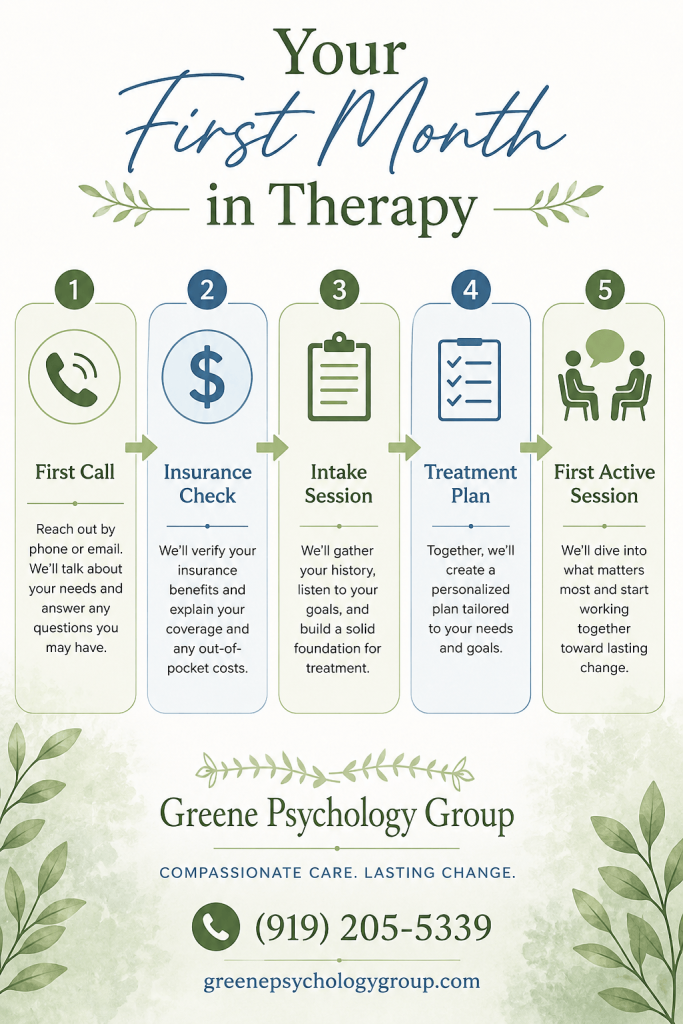
Part 1: The Initial Contact – What Happens When You Call (919) 205-5339
The therapy process in North Carolina almost always begins with a brief phone call. At Greene Psychology Group, that call is not a sales conversation. It is a clinical triage.
When you call (919) 205-5339), our intake coordinator will ask you four things:
Your primary reason for seeking therapy – a few words are fine ("anxiety," "depression," "relationship problems," "I'm not sure, but something is wrong").
Whether you prefer in‑person or telehealth – we offer both from our Raleigh office.
Your insurance information – so we can verify benefits before you pay anything.
Any urgent safety concerns – if you are in crisis, we will connect you to immediate resources.
This call takes 10–15 minutes. It is completely confidential under HIPAA and North Carolina state privacy laws (NC GS 122C-52) . You will never be pressured to schedule or to share details you are uncomfortable disclosing.
What does NOT happen on this call: We do not diagnose you. We do not ask for your entire life story. We do not require a credit card before we verify your insurance.
Part 2: Insurance Verification and Real Costs – What You Will Actually Pay
One of the biggest sources of anxiety about the therapy process in North Carolina is cost. Let me be direct: therapy is an investment, but it is far less expensive than most people assume—especially when you account for what untreated mental illness costs in lost work, strained relationships, and physical health problems.
Average Costs Without Insurance (Raleigh market)
| Service Type | Average Market Rate | Greene Psychology Group Rate |
|---|---|---|
| Individual therapy (50 min) | $150–250 | $175 |
| Couples therapy (50 min) | $175–300 | $200 |
| Group therapy (90 min) | $40–80 | $60 |
| Psychological testing (comprehensive) | $1,500–3,500 | Not offered (referral provided) |
Insurance Plans We Accept at Greene Psychology Group
- Blue Cross Blue Shield of North Carolina (all PPO and HMO plans)
- Cigna (including Evernorth behavioral health)
- UnitedHealthcare / Optum
- Aetna (including Meritain)
- MedCost
- Carolina Behavioral Health Alliance (CBHA)
- NC State Health Plan
- Medicare (Parts A and B for qualifying conditions)
- TriCare (East region)
How to verify your out-of-pocket cost before your first session
Call the member services number on the back of your insurance card and ask these four questions:
- "Do I have outpatient mental health coverage?"
- "What is my deductible, and how much has been met?"
- "What is my copay or coinsurance for in-network providers?"
- "Do I need prior authorization for weekly therapy?"
If you do not want to use insurance, Greene Psychology Group also offers a sliding scale under NC GS 131D-6.5 for patients with household income below 200% of the federal poverty level. Call (919) 205-5339 to ask about current sliding-scale availability.
Part 3: The Intake Assessment – What Happens in Your First 90 Minutes
The first official session of the therapy process in North Carolina is not the same as a regular therapy session. It is an intake assessment. This is a 90‑minute meeting designed to answer three questions:
What is the actual problem? (diagnosis, if applicable)
What level of care is appropriate? (weekly therapy, intensive outpatient, or referral to a higher level)
What are the measurable goals for treatment?
During this session, your Greene Psychology Group therapist will:
Review informed consent documents – including North Carolina's mandatory disclosure of limits to confidentiality (duty to warn/protect under NC GS 122C-54, child/elder abuse reporting, and imminent suicide risk).
Complete a diagnostic assessment – using criteria from the DSM‑5‑TR. This is not a test you can fail. It simply helps us choose the right treatment.
Discuss treatment goals using the SMART framework (Specific, Measurable, Achievable, Relevant, Time‑bound).
Determine level of care – most clients begin with weekly 50‑minute sessions. Some need intensive outpatient (IOP) or a psychiatric referral for medication.
What you should bring to intake: Your insurance card, a list of current medications, any prior therapy records (if available and you want to share them), and a list of questions you have.
What you should NOT expect: You do not need to have your "whole story" prepared. You do not need to know your diagnosis beforehand. You do not need to decide how many sessions you will attend.
Part 4: North Carolina’s Unique Therapy Rules – What You Must Know
The therapy process in North Carolina operates under specific state laws that differ from other states. Understanding these rules protects your rights and prevents surprises.
Licensure Requirements
Only professionals licensed by the North Carolina Psychology Board or the North Carolina Social Work Certification and Licensure Board can legally provide therapy. Greene Psychology Group employs:
Licensed Psychologists (PhD or PsyD) – Doctoral‑level providers who can diagnose all mental disorders and perform psychological testing (though we refer out for testing).
Licensed Clinical Social Workers (LCSW) – Master’s level with 3,000 supervised hours.
Licensed Professional Counselors (LPC) – Master’s level with 3,000 supervised hours.
Licensed Marriage and Family Therapists (LMFT) – Specialized in relational issues.
Verify any therapist’s license through the North Carolina Psychology Board’s online verification portal before your first session.
Telehealth Rules in North Carolina
Following the end of the COVID‑19 public health emergency, North Carolina permanently adopted telehealth parity laws (Session Law 2021-110). Key provisions:
Location requirement: You must be physically located in North Carolina during telehealth sessions (even if your therapist is licensed elsewhere).
Platform security: Therapy must occur on HIPAA‑compliant platforms. Greene Psychology Group uses SimplePractice and Doxy.me.
Insurance coverage: NC insurers must reimburse telehealth at the same rate as in‑person visits through December 2026.
Prescribing restrictions: Only psychiatrists (MD/DO) and psychiatric nurse practitioners can prescribe medications via telehealth. Psychologists cannot prescribe in North Carolina.
Confidentiality Exceptions Under NC Law
While most therapy communications are privileged under NC GS 8-53.3, exceptions require disclosure:
Duty to warn if you make a specific threat of serious harm to an identifiable victim (Tarasoff duty).
Child abuse – mandated reporting to Wake County Child Protective Services (919-212-7900).
Elder abuse – report to NC Department of Health and Human Services (800-662-7030).
Imminent suicide risk – your therapist may contact emergency contacts or 911.
These exceptions are rare. Your therapist will explain them clearly during your intake session.
Part 5: The Active Treatment Phase – What Weekly Therapy Actually Looks Like
```html id="h1q7zn"
Most clients spend 12–20 weeks in the active treatment phase of the therapy process in North Carolina. A standard 50-minute session at Greene Psychology Group follows a predictable structure:
| Time | Activity | What That Means |
|---|---|---|
| 0–5 min | Check-in | "How has your week been since we last met?" |
| 5–15 min | Review homework | Did you practice the skill we discussed? What came up? |
| 15–40 min | Active intervention | CBT worksheet, EMDR processing, DBT skills practice, exposure exercise, etc. |
| 40–45 min | Summarize insights | "What is the most important thing you learned today?" |
| 45–50 min | Assign new practice | "Between now and our next session, I would like you to try…" |
Evidence-Based Therapies We Use at Greene Psychology Group
Research from Duke University’s Cognitive Behavioral Research Program and Harvard Medical School’s Department of Psychiatry supports these approaches:
Cognitive Behavioral Therapy (CBT) – 16–20 sessions. Targets automatic negative thoughts. Success rate: 60–75% symptom reduction for anxiety and depression. Learn more about CBT at Greene Psychology Group.
Eye Movement Desensitization and Reprocessing (EMDR) – 8–12 sessions. For PTSD and trauma. Explore EMDR therapy in Raleigh.
Dialectical Behavior Therapy (DBT) – 24‑week skills group plus individual coaching. For emotion dysregulation and chronic suicidality.
Couples Counseling – Based on Integrative Behavioral Couple Therapy (IBCT) and Emotionally Focused Therapy (EFT). Couples counseling in Raleigh.
Family Therapy – Targets interaction patterns and communication. Family therapy to heal together.
Mindfulness Therapy – Integrated with CBT and ACT to build present‑moment awareness. Mindfulness therapy at Greene Psychology Group.
Anxiety Therapy – Structured exposure and CBT protocols. Anxiety therapy in Raleigh.

Part 6: How to Know If Therapy Is Working – Measurable Benchmarks
One of the most common frustrations patients express is not knowing whether they are making progress. The therapy process in North Carolina should be transparent. At Greene Psychology Group, we track progress using two methods:
1. Standardized symptom questionnaires
PHQ‑9 for depression (score range 0–27)
GAD‑7 for anxiety (score range 0–21)
We administer these every 4–6 sessions. A reduction of 5+ points is clinically significant.
2. Personal treatment goals
At intake, you set 2–3 SMART goals (e.g., "By session 12, I will attend one social gathering per week without panic.")
We review these goals every 6 weeks.
What if you are not improving? If after 8–10 sessions there is no measurable change, your therapist should:
Re‑evaluate the diagnosis
Consider a different treatment modality (e.g., switching from CBT to EMDR)
Refer you to a different provider or higher level of care
Greene Psychology Group has a no‑shame second opinion policy: if you feel stuck, we will help you find another clinician inside or outside our practice.
Part 7: Termination and Discharge – How Therapy Ends Intentionally
The final phase of the therapy process in North Carolina is often overlooked, but it is essential. Therapy should not end abruptly. It ends intentionally.
Signs You Are Ready for Discharge
- You have achieved your original treatment goals for 4–6 consecutive weeks.
- You can independently manage symptoms using the skills you learned.
- You have a written relapse prevention plan (what to do if symptoms return).
- You and your therapist agree that continuing weekly sessions is no longer "medically necessary."
Greene Psychology Group offers booster sessions – monthly or quarterly check-ins after formal discharge. Booster sessions reduce relapse rates by approximately 40%, according to research from UNC Chapel Hill.
Putting It All Together: Three Patient Archetypes
To make the therapy process in North Carolina concrete, here are three hypothetical patients and how their treatment might unfold.
Archetype A: The Anxious Professional
Presentation: 34-year-old project manager with panic attacks before meetings, insomnia, and constant worry about job performance.
Bottleneck: Generalized anxiety disorder with panic features.
Treatment map: Intake → 16 weeks of CBT (exposure therapy for panic, cognitive restructuring for worry) → PHQ-9/GAD-7 shows 60% reduction → Discharge with booster sessions every 3 months.
Archetype B: The Couple in Crisis
Presentation: Married 12 years, constant arguing about parenting and finances, considering separation.
Bottleneck: Communication breakdown and emotional disconnection.
Treatment map: Intake (both partners) → 12 weeks of Emotionally Focused Therapy (EFT) → 6 weeks of communication skills training → Discharge with quarterly check-ins.
Archetype C: The Trauma Survivor
Presentation: 28-year-old with flashbacks, hypervigilance, and avoidance after a car accident 18 months ago.
Bottleneck: PTSD.
Treatment map: Intake → 8 sessions of EMDR (processing traumatic memory) → 8 sessions of CPT (cognitive processing therapy) → PHQ-9 drops from 22 to 8 → Discharge.
Why Greene Psychology Group Approaches Therapy Differently
We do not offer one‑size‑fits‑all therapy. We do not pressure you into long‑term contracts. We do not shame you for asking about cost or insurance.
What we do:
Evidence‑based: Every therapy we offer is supported by peer‑reviewed research.
Transparent: You will know your diagnosis, your goals, and your progress.
Local: Our Raleigh office serves all of Wake County, including 27601, 27609, 27612, and 27615.
Flexible: In‑person or telehealth, weekday or evening appointments.
Ready to start the therapy process in North Carolina with a team that prioritizes evidence, transparency, and your goals? Call Greene Psychology Group at (919) 205-5339 or schedule an appointment online. Same‑week availability for new clients.
FAQ Section
The average course of therapy is 12-20 sessions, but this varies based on your goals and the specific condition being treated.
No, North Carolina allows direct access to licensed therapists without a physician referral.
Yes, research shows online therapy produces comparable outcomes to in-person care for most conditions.
Call the member services number on your insurance card and ask about outpatient mental health benefits.
Psychologists hold doctoral degrees (PhD or PsyD) and can perform psychological testing; counselors hold master’s degrees and focus on talk therapy.
Absolutely; we encourage clients to find the right therapeutic match and will help facilitate a transfer.
We typically schedule new clients within 1-2 weeks, with priority for urgent concerns.
We have a 24-hour cancellation policy; missed sessions without notice may incur a fee.
Yes, with exceptions for imminent danger, child/elder abuse, or court order.
Yes, we offer couples and family therapy in addition to individual treatment.
Sources
Harvard Medical School – Effectiveness of CBT for Anxiety Disorders
Duke University Department of Psychiatry – Telehealth Outcomes in NC
UNC Chapel Hill School of Social Work – Therapy Termination Best Practices
Johns Hopkins Bloomberg School of Public Health – Mental Health Parity Laws
National Institute of Mental Health (NIMH) – Psychotherapies
American Psychological Association (APA) – Choosing a Psychologist