
If you are searching for the most effective way to treat anxiety in Raleigh NC, you have likely encountered conflicting advice: therapy, medication, or simply "talking it out." The confusion often leads to paralysis – and staying stuck in the cycle of worry, panic, and avoidance. Greene Psychology Group has helped hundreds of Raleigh residents navigate this exact decision. This evidence‑based guide compares Cognitive Behavioral Therapy (CBT), medication (SSRIs), and general counseling, giving you a clear framework to choose the right path for your specific situation. Understanding how to treat anxiety in Raleigh NC starts with knowing what each approach actually does – and what the research says about their effectiveness.
If you are one of the 40 million American adults struggling with anxiety, you have probably already asked yourself a version of the same question: What is the best way to treat this?
- Should I try therapy?
- Medication?
- Both?
- What about "just talking it out" with a counselor?
The options can feel overwhelming – and the opinions are everywhere. Social media influencers swear by one approach. Your primary care doctor might recommend another. Your well‑meaning friend says, "Have you tried essential oils?"
This confusion has a cost. When people do not know which path to take, many take no path at all. They stay stuck in the cycle of worry, panic, and avoidance – sometimes for years.
Greene Psychology Group has helped hundreds of Raleigh residents navigate this decision. This guide is not about declaring a single "winner." It is about giving you a clear, evidence‑based framework to understand CBT vs. medication vs. counseling for anxiety – including how each works, the research behind them, the pros and cons, and most importantly, how to choose based on your specific situation.
Part 1: How to Treat Anxiety in Raleigh NC – Three Approaches Compared
Before we dive into the details, let me define each approach clearly.
Cognitive Behavioral Therapy (CBT)
CBT is a structured, goal‑oriented therapy that focuses on the relationship between thoughts, feelings, and behaviors. It is the most researched psychological treatment for anxiety disorders. A typical course is 12–20 sessions.
Medication (SSRIs/SNRIs)
Selective serotonin reuptake inhibitors (SSRIs) and serotonin‑norepinephrine reuptake inhibitors (SNRIs) are the first‑line medications for anxiety. Common examples: sertraline (Zoloft), escitalopram (Lexapro), venlafaxine (Effexor XR).
Note: These are prescribed by psychiatrists or primary care physicians – psychologists cannot prescribe in North Carolina.
General Counseling (Supportive Therapy)
"Counseling" is a broad term. In this guide, I am referring to general supportive counseling – non‑structured talk therapy that focuses on emotional expression, validation, and practical problem‑solving without a specific evidence‑based protocol.
Important distinction: Some licensed counselors practice CBT or other evidence‑based modalities. The problem is not the title "counselor"; it is the approach. In this guide, "counseling" refers to supportive therapy, not evidence‑based CBT delivered by a counselor.
Part 2: How CBT Works for Anxiety – The Gold Standard
CBT is the most rigorously studied psychological treatment for anxiety disorders. Dozens of randomized controlled trials have demonstrated its effectiveness for panic disorder, social anxiety, generalized anxiety disorder (GAD), specific phobias, and obsessive‑compulsive disorder.For anyone looking to treat anxiety in Raleigh NC, CBT offers the strongest long‑term evidence with no side effects.
The Core Mechanisms of CBT for Anxiety
1. Psychoeducation
You learn how anxiety works – the fight‑or‑flight response, the role of the amygdala, and why your body reacts the way it does. This alone reduces anxiety for many patients because the unknown is scarier than the known.
2. Cognitive Restructuring
You learn to identify automatic negative thoughts (e.g., "I'm going to have a panic attack and everyone will think I'm crazy") and challenge them with evidence. Over time, this changes the neural pathways that maintain anxiety.
3. Exposure Therapy
This is the active ingredient for most anxiety disorders. You gradually and repeatedly face feared situations (or internal sensations, in panic disorder) until the anxiety naturally decreases. Exposure sounds scary, but it is done in a controlled, step‑by‑step way.
4. Behavioral Experiments
You test your anxious predictions in real life. For example: "If I speak up in this meeting, I will stutter and everyone will laugh." You speak up. You do not stutter. No one laughs. The prediction is disconfirmed, and the anxiety weakens.
Evidence for CBT
A 2023 network meta‑analysis in JAMA Psychiatry reviewed 124 trials involving over 12,000 patients. CBT outperformed all other psychological treatments for anxiety disorders, with a response rate of 62% (compared to 28% for waitlist controls). The benefits lasted at least 12 months after treatment ended.
Research from Harvard Medical School's Department of Psychiatry found that CBT for panic disorder produced complete remission in 75% of patients at 6‑month follow‑up.
Pros of CBT
No side effects (unlike medication)
Teaches lifelong skills you can use after therapy ends
Addresses root causes, not just symptoms
60–75% response rate for most anxiety disorders
Prevents relapse better than medication alone
Cons of CBT
Requires active participation and homework between sessions
Takes 12–20 weeks to see full benefits
Can temporarily increase anxiety during exposure work (this is expected and managed)
Requires a trained CBT therapist (not all therapists practice true CBT)
At Greene Psychology Group, we offer specialized CBT for anxiety delivered by licensed clinicians with advanced training in exposure therapy.
Part 3: How Medication Works for Anxiety
SSRIs and SNRIs are the most commonly prescribed medications for anxiety disorders. They work by increasing the availability of serotonin (and sometimes norepinephrine) in the brain, which modulates mood and fear responses.
The Mechanism
These medications do not "fix" a chemical imbalance in the way popular culture suggests. Instead, they promote neuroplasticity – making it easier for the brain to form new, less anxious patterns. This is why medication is often most effective when combined with CBT: the medication creates the biological conditions for learning, and CBT provides the learning.
Evidence for Medication
A 2021 systematic review in The Lancet analyzed 89 trials of SSRIs for anxiety disorders. The average response rate was 55% (compared to 35% for placebo). However, "response" typically means a 50% reduction in symptoms – not complete remission. Complete remission occurs in about 30–40% of patients.
Common Side Effects
| Side Effect | Frequency |
|---|---|
| Nausea | 20–30% (usually temporary) |
| Insomnia or drowsiness | 15–25% |
| Sexual dysfunction (reduced libido, delayed orgasm) | 30–50% |
| Weight gain | 10–20% (long‑term) |
| Emotional blunting | 10–15% |
Pros & Cons of Medication
Pros of Medication
- No need for weekly therapy appointments (though follow‑up with prescriber is needed).
- Can be effective for severe anxiety that interferes with therapy engagement.
- Often covered by insurance.
- Works "from the bottom up" (biological level).
Cons of Medication
- Side effects are common and sometimes intolerable.
- Takes 4–8 weeks to work.
- Does not teach coping skills – symptoms often return when medication stops.
- Risk of withdrawal symptoms (discontinuation syndrome) if stopped abruptly.
- Does not address the behavioral patterns (avoidance) that maintain anxiety.
Note on prescribing in North Carolina: Psychologists cannot prescribe medication. You would need to see a psychiatrist (MD/DO) or a psychiatric nurse practitioner. Greene Psychology Group maintains a referral list of trusted prescribers in Raleigh.
Part 4: How General Counseling Works for Anxiety
General supportive counseling is what many people imagine when they think of "therapy": a warm, empathetic professional who listens, validates, and offers gentle advice.
What Happens in Counseling Sessions
You talk about your week, your stressors, your feelings.
The counselor offers empathy and normalization ("It makes sense you feel anxious given what you are going through").
You might brainstorm practical solutions to immediate problems.
There is no structured protocol, no exposure exercises, no formal cognitive restructuring.
Evidence for Counseling
Supportive counseling is better than nothing. A 2020 meta‑analysis in Psychological Medicine found that supportive counseling produced a small to moderate effect on anxiety symptoms (Cohen's d = 0.38). However, CBT produced a large effect (d = 0.86) – more than double the benefit.
For panic disorder and social anxiety specifically, CBT significantly outperformed supportive counseling in every head‑to‑head trial.
Pros of Counseling
Low barrier to entry – feels less "intimidating" than structured CBT
Helpful for mild, situational anxiety (e.g., stress from a life transition)
Builds a trusting relationship that may make future evidence‑based therapy more accessible
No homework required
Cons of Counseling
Less effective for clinical anxiety disorders (GAD, panic, social anxiety, OCD)
Does not include exposure therapy – the most powerful tool for anxiety
Can become an indefinite "talking" without measurable progress
May inadvertently reinforce avoidance (if the counselor validates staying home rather than facing fears)
Critical nuance: Some counselors practice CBT even if they do not call it that. The question is not the license (LCSW, LPC, LMFT) but the method. Ask potential providers: "Do you use exposure therapy? Do you assign between‑session homework? Do you track symptoms with standardized questionnaires?"
Part 5: Comparing Effectiveness to Treat Anxiety in Raleigh NC
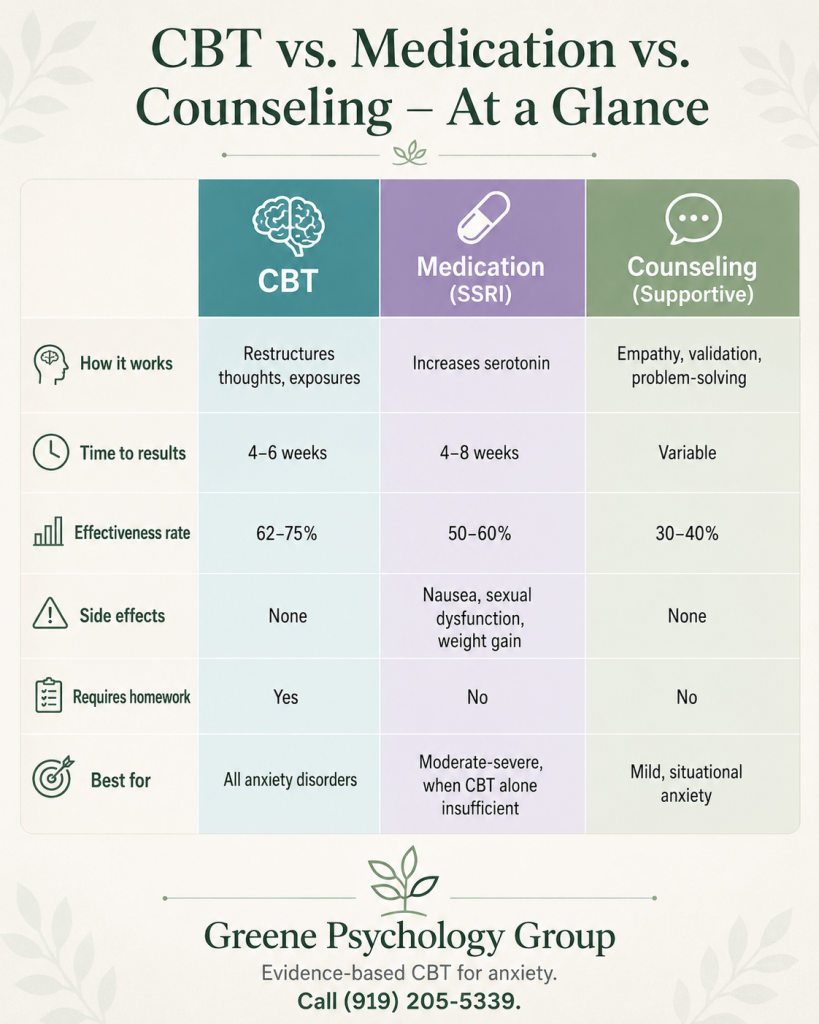
| Factor | CBT | Medication (SSRI) | Counseling (Supportive) |
|---|---|---|---|
| Effectiveness (response rate) | 62–75% | 50–60% | 30–40% |
| Time to initial improvement | 4–6 weeks | 4–8 weeks | Variable (often slower) |
| Duration of benefit after stopping | Months to years (skills persist) | Weeks (symptoms return for most) | Variable |
| Side effects | None | Nausea, sexual dysfunction, weight gain | None |
| Requires homework | Yes | No | No |
| Addresses avoidance (the core of anxiety) | Yes (exposure) | No (indirectly via symptom reduction) | Rarely |
| Relapse prevention | Strong (skills) | Weak (symptoms return) | Weak |
| Insurance coverage | Yes | Yes | Yes |
| Best for | All anxiety disorders | Moderate‑severe anxiety, when CBT alone insufficient | Mild, situational anxiety; as a gateway to CBT |
Part 6: Combination Treatment – CBT + Medication
For many patients with moderate to severe anxiety, the best answer to CBT vs. medication vs. counseling is not "either/or" but "both."
Evidence for Combination Treatment
A 2019 study from Duke University Department of Psychiatry randomly assigned 400 patients with moderate‑severe GAD to one of four conditions: CBT alone, medication alone (escitalopram), CBT + medication, or placebo. After 12 weeks:
CBT alone: 65% response rate
Medication alone: 58% response rate
CBT + medication: 78% response rate (statistically superior to either alone)
Placebo: 32% response rate
At 6‑month follow‑up (after medication was discontinued), the CBT + medication group maintained their gains better than the medication‑alone group, demonstrating that the CBT skills persisted.
Who Should Consider Combination Treatment?
Severe anxiety (e.g., unable to leave home, frequent panic attacks, significant weight loss from anxiety)
Partial response to CBT alone (e.g., improved but still symptomatic after 12 sessions)
Co‑occurring depression (medication often helps both)
Patient preference for medication
How to Do Combination Treatment Safely
Start CBT first (or simultaneously). Do not rely on medication alone.
See a psychiatrist for medication management. Greene Psychology Group can provide referrals.
Stay on medication for at least 6–12 months after achieving remission.
Taper medication slowly (under prescriber guidance) while continuing CBT booster sessions.
Use CBT skills during the taper to manage any return of symptoms.
Part 7: How to Choose – A Decision Framework
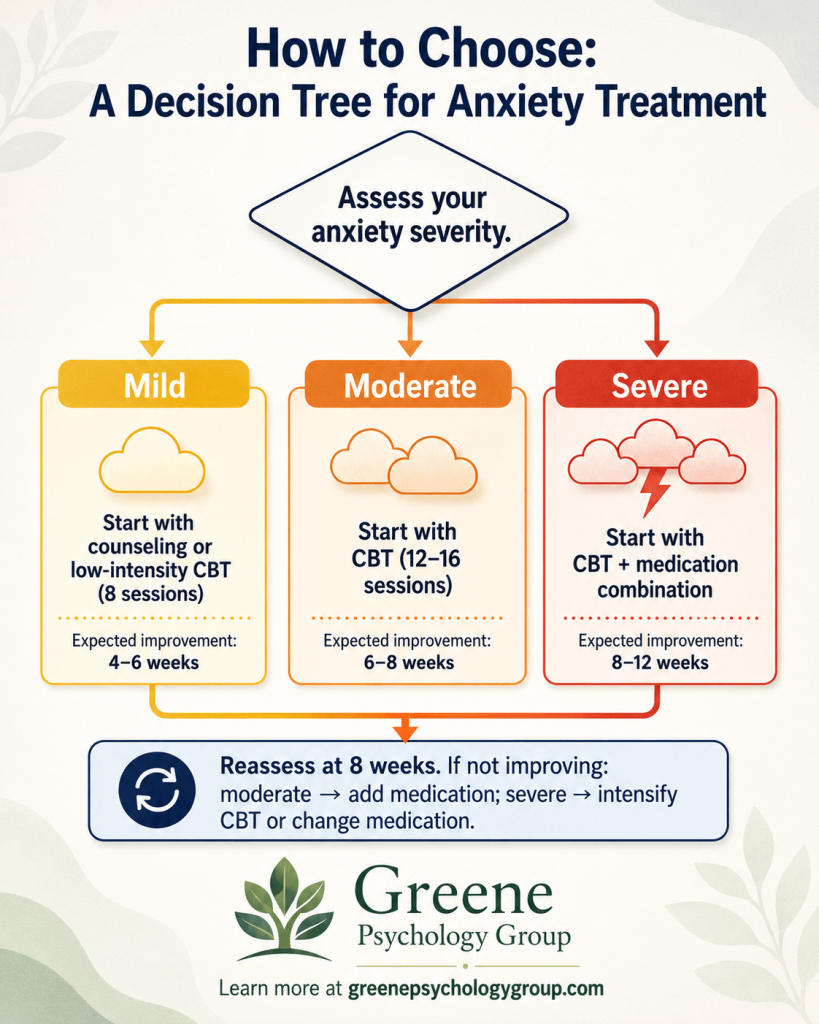
Here is a simple decision tree to help you choose among CBT, medication, and counseling.
Step 1: Assess Severity
Mild anxiety (occasional worry, minimal interference with daily life): Start with counseling or low‑intensity CBT (e.g., self‑guided workbook, 8 sessions).
Moderate anxiety (frequent worry, avoidance of some situations, noticeable interference): Start with CBT. If CBT is not accessible or you prefer medication, consider medication alone.
Severe anxiety (panic attacks multiple times per week, unable to work or socialize, significant weight loss, suicidal thoughts): Start with CBT + medication combination. Do not rely on counseling alone.
Step 2: Consider Your Preferences and Constraints
Do you have time for weekly 50‑minute sessions and homework? If yes, CBT is a great fit. If no (e.g., traveling, shift work), medication may be more practical.
Are you willing to tolerate temporary side effects? If no, CBT is better. If yes, medication is an option.
Do you want a "lifelong skill" or a "while‑I‑take‑it" solution? CBT provides skills. Medication provides symptom relief while you take it.
Step 3: Try the Least Invasive Option First (Usually CBT)
Because CBT has no side effects and produces durable skills, it is the appropriate first‑line treatment for most people with anxiety disorders. Only if CBT fails (after an adequate trial of 12–16 sessions) or is inaccessible should medication be considered first.
Step 4: Reassess at 8 Weeks
If you are improving with CBT alone, continue.
If you are not improving (or improving too slowly), add medication or switch to a more intensive CBT protocol (e.g., more sessions, exposure‑focused).
If you are on medication and have achieved remission, consider adding CBT before tapering off.
Part 8: What Greene Psychology Group Offers
Greene Psychology Group specializes in evidence‑based treatment for anxiety. We do not offer medication (psychologists cannot prescribe), but we do offer:
CBT for anxiety – structured, exposure‑based, homework‑inclusive
Online therapy (same effectiveness as in‑person for anxiety)
Referrals to trusted psychiatrists in Raleigh for medication
We also offer CBT for depression and family therapy when anxiety affects loved ones.When you are ready to treat anxiety in Raleigh NC with an evidence‑based approach, Greene Psychology Group is here to help.
Internal resource: For a deeper dive into what happens when anxiety goes untreated, see our guide: Consequences of Delaying Mental Health Treatment.
Part 9: A Note on "Natural" and "Alternative" Anxiety Treatments
Many people ask about supplements (magnesium, ashwagandha, CBD), breathing exercises, or lifestyle changes. Here is the evidence:
Breathing exercises and mindfulness are helpful adjuncts to CBT but are not sufficient for moderate‑severe anxiety on their own. They reduce symptoms by about 10–20%.
Supplements have limited evidence. Some small studies show modest benefit for ashwagandha or L‑theanine, but none are FDA‑approved for anxiety disorders. Do not rely on supplements as first‑line treatment.
Exercise is excellent for mental health and reduces anxiety symptoms by about 20–30%. It is not a replacement for CBT or medication but a valuable addition.
If you choose to try supplements, tell your therapist and doctor. Some interact with medications.
You do not have to figure this out alone. If you are struggling with anxiety in Raleigh, call Greene Psychology Group at (919) 205-5339 or schedule an appointment online. We will help you understand your options, verify your insurance, and match you with a therapist who specializes in CBT for anxiety. Same‑week availability for new clients.
FAQs
CBT is slightly more effective in head‑to‑head trials (62–75% response vs. 50–60% for medication) and has longer‑lasting benefits. Combination treatment is best for severe anxiety.
Yes. Research shows combination treatment is superior to either alone for moderate‑severe anxiety.
Most people notice improvement within 4–6 weeks, with full benefits by 12–20 sessions.
No. Medication suppresses symptoms while you take it. When you stop, symptoms usually return unless you have learned coping skills (e.g., from CBT).
Not necessarily. For mild, situational anxiety, supportive counseling can help. But for clinical anxiety disorders (GAD, panic, social anxiety), CBT is significantly more effective.
Yes. Research shows online CBT (video sessions) is as effective as in‑person CBT for most anxiety disorders.
No. Psychologists cannot prescribe in North Carolina. We can refer you to trusted psychiatrists in Raleigh.
Common side effects include nausea (first few weeks), sexual dysfunction (30–50%), weight gain, and emotional blunting. These vary by person and medication.
If anxiety interferes with your work, relationships, sleep, or daily activities, you deserve treatment. There is no minimum severity threshold.
If anxiety interferes with your work, relationships, sleep, or daily activities, you deserve treatment. There is no minimum severity threshold.
Yes. CBT is the first‑line treatment for childhood anxiety disorders. Greene Psychology Group sees adolescents (14+) for individual therapy.
First, ensure you received real CBT (exposure, homework, structured sessions). If you did and still did not improve, consider adding medication, trying a different CBT therapist, or exploring EMDR (for trauma‑related anxiety).
CBT and counseling have similar per‑session costs (150–150–200). Medication has lower per‑month costs (10–10–50) but requires prescriber visits. Insurance often covers all three.
Sources
Duke University Department of Psychiatry – Combination Treatment Research
Johns Hopkins Bloomberg School of Public Health – Anxiety Treatment Guidelines
UNC Chapel Hill School of Social Work – Supportive Counseling Outcomes
Stanford University Department of Psychiatry – Neuroplasticity and CBT
Columbia University Department of Psychiatry – Exposure Therapy Mechanisms
National Institute of Mental Health (NIMH) – Anxiety Disorders Treatment