

When to Seek Therapy: 4 Safe Support Options to Know
Quick answer: Knowing when to seek therapy often starts with one practical question: can this safely wait for scheduled outpatient care, or does someone need support today? Routine therapy may be a good next step when anxiety, low mood, stress, grief, relationship strain, parenting concerns, or life changes are persistent or disruptive but there is no immediate danger. If there is immediate danger or thoughts of harming self or others, call 911 or go to the nearest emergency room. For a mental-health or suicidal crisis, call or text 988 or chat through the 988 Lifeline. Greene Psychology Group is not a crisis service.
How to understand when to seek therapy without using a checklist
Many people wait to ask for mental health help because they worry their concerns are not “serious enough.” Others wonder whether they should wait it out, talk to a friend, schedule therapy, call 988, or seek more immediate support. It can feel especially confusing when the concern is not a clear emergency but also does not feel manageable.
A helpful starting point is to separate four different support options: routine outpatient therapy, 988 crisis support, local same-day crisis resources, and emergency care. Routine therapy is scheduled care with a licensed clinician. It gives a person space to talk through what is happening, understand patterns, consider goals, and decide whether ongoing outpatient psychotherapy fits the concern. It is not designed to be an immediate crisis response.
The goal of this guide is not to diagnose anyone. It is to help with a practical therapy or crisis decision. Reflection prompts can help: What has changed? Is daily life harder to manage? Is there any immediate safety concern? Would a neutral, trained person be useful right now? If safety is uncertain, the decision shifts away from routine scheduling and toward same-day or emergency support.
The National Institute of Mental Health describes psychotherapy as talk therapy that can help people identify and change troubling emotions, thoughts, and behaviors. That does not mean therapy is the right level of care for every situation, or that it works the same way for everyone. It does mean that talking with a licensed clinician can be an appropriate next step when concerns are ongoing and there is time to schedule care safely.
Common reasons people look for mental health help
Seeking therapy does not require a diagnosis, a crisis, or proof that things are “bad enough.” Many people contact a therapist because something in life has become harder to carry alone. They may still be working, parenting, studying, showing up for others, or appearing steady from the outside. That does not mean support is unnecessary.
Common reasons adults and parents of teens seek mental health help include:
- Persistent worry, tension, panic-like episodes, or feeling unable to settle.
- Low mood, loss of interest, irritability, hopelessness, or emotional numbness.
- Stress, burnout, or feeling overloaded by work, caregiving, school, family, or life transitions.
- Grief, loss, or difficulty adjusting after a major change.
- Relationship strain, communication problems, conflict, or feeling disconnected.
- Parenting concerns, family stress, or worry about a teenager’s mood or behavior.
- Trauma-related distress, intrusive memories, avoidance, or feeling on edge.
- Difficulty concentrating, regulating emotions, sleeping consistently, or keeping up with routines.
These concerns can exist on a wide range. Some people benefit from a few focused conversations; others need longer-term support or a different level of care. A licensed clinician can assess the concern, discuss goals, and help decide whether outpatient therapy is a reasonable fit. A therapist should also help reassess if needs change.
For adults and adolescents looking for scheduled outpatient support, Greene Psychology Group offers individual therapy and mental health therapy. The practice is not a walk-in clinic, crisis center, emergency service, inpatient program, or medication-prescribing practice.
Reflection prompts before deciding therapy or crisis support
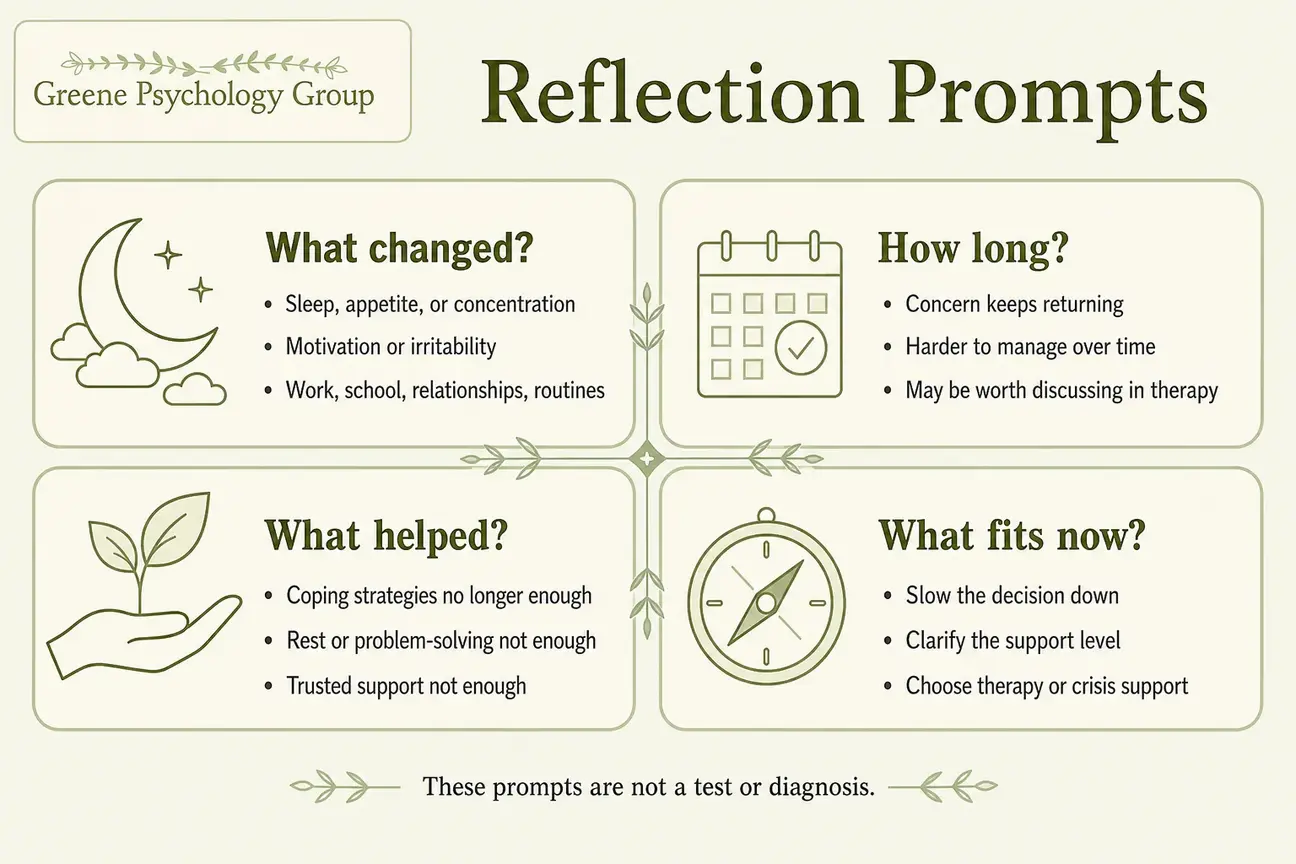
When deciding between routine therapy or crisis support, try to slow the decision down enough to ask practical questions. These are not a test, and they cannot diagnose a mental-health condition. They are prompts to help clarify what level of support may fit the moment.
Consider the following:
- What has changed? Notice changes in sleep, appetite, concentration, motivation, irritability, work, school, relationships, or daily routines.
- How long has this been going on? A concern that keeps returning or is becoming harder to manage may be worth discussing with a therapist.
- What has helped before? If coping strategies, rest, problem-solving, or support from trusted people are no longer enough, therapy may be worth considering.
- What is being affected? Pay attention to whether responsibilities, relationships, parenting, school, work, or self-care are becoming difficult to maintain.
- Would a neutral person help? Sometimes support from friends or family is caring but not enough. A licensed clinician can provide structure and perspective.
- Is anyone unsafe right now? If there is immediate danger, thoughts of harming self or others, or an inability to stay safe, do not wait for routine therapy.
The last prompt is the most important dividing line. Routine outpatient therapy can be helpful when the situation is difficult but stable enough to wait for an appointment. If the concern involves immediate danger, escalating crisis, or uncertainty about safety, it is time to use same-day or emergency resources.
When urgent mental health care may be the safer next step
Urgent mental health care may be needed when the situation cannot reasonably wait for a scheduled therapy appointment. This might include concern that someone may harm themselves or another person, cannot remain safe, is experiencing a mental-health or substance-use crisis, or is too distressed or disorganized to wait for routine care.
The North Carolina Department of Health and Human Services gives a clear emergency threshold: NCDHHS says to call 911 if this is a life-threatening emergency. If there is immediate danger or thoughts of harming self or others, call 911 or go to the nearest emergency room.
There are also situations that feel urgent but are not clearly life-threatening. A person may be intensely distressed, overwhelmed, frightened by their own thoughts, worried about a loved one, or unsure whether the situation is safe. In those moments, urgent mental health care may begin with 988, which can connect someone with a crisis counselor by phone, text, or chat.
It is important not to use routine therapy as a substitute for crisis care. A therapist’s voicemail, email, contact form, or scheduling system may not be monitored in real time. Greene Psychology Group is not a crisis service. Do not wait for a routine therapy response during an emergency or mental-health crisis.
Therapy or crisis: the 4 safe support options
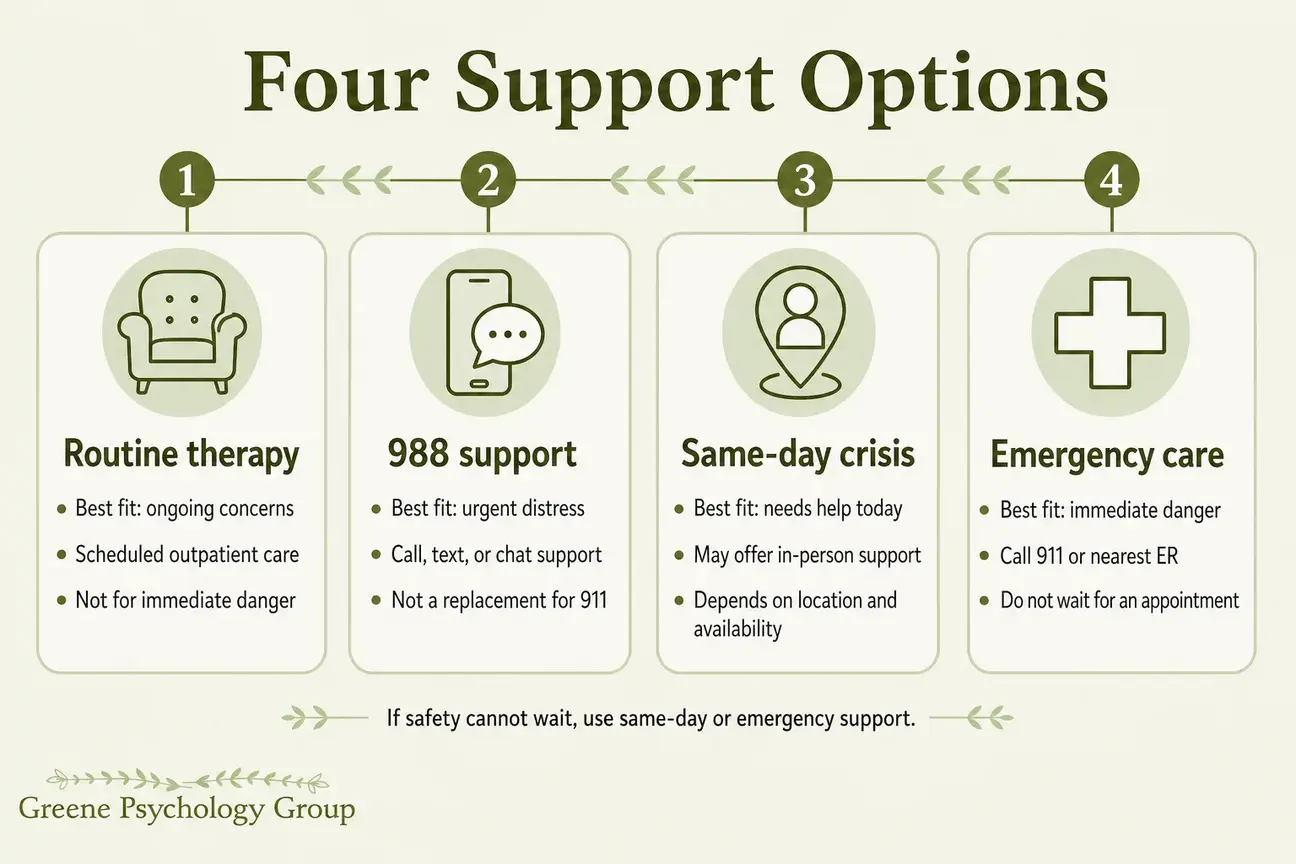
The question of therapy or crisis support can be easier when timing and safety are the focus. Routine therapy is scheduled outpatient care. Crisis support is for urgent situations where someone needs help today. Emergency services are for life-threatening danger, serious medical emergencies, or situations where immediate responders are needed.
The four options below are a navigation aid, not a substitute for professional judgment. If the situation may involve immediate danger, use emergency support.
1. Routine outpatient therapy for concerns that can safely wait
Routine outpatient therapy is usually the best starting point when concerns are persistent or disruptive but there is no immediate danger. This may include ongoing anxiety, low mood, stress, grief, relationship concerns, parenting concerns, trauma-related distress, or life transitions that feel hard to manage alone.
In routine therapy, a licensed clinician can ask questions, assess whether outpatient care fits, and work with the client on goals. This is scheduled care, so it is not the right option when someone needs immediate safety support.
2. 988 crisis support for urgent emotional distress
The 988 or therapist question often comes up when a person is distressed but not sure what kind of help fits. A therapist is the better fit for scheduled outpatient care when the situation is not urgent and can safely wait for an appointment. 988 is the better fit when there is urgent emotional distress, a mental-health or suicidal crisis, or concern about someone else that needs guidance now.
The 988 Lifeline offers call, text, and chat support for people experiencing suicidal crisis, mental-health-related distress, or worry about someone else. Choosing 988 or therapist is not about whether someone’s pain is valid. It is about timing and safety.
988 is not a replacement for 911 in life-threatening danger. If someone is in immediate physical danger, has a serious medical emergency, or needs emergency responders right away, call 911 or go to the nearest emergency room.
3. Local same-day crisis resources for in-person support when appropriate
Some situations fall between scheduled therapy and an emergency department. A person may need urgent mental health care, but the safest starting point may not be a routine therapist’s office. North Carolina’s crisis system includes local options that may help people connect with same-day or in-person support, depending on location and current availability.
Mobile crisis teams are intended for situations where in-person crisis support may be appropriate. NCDHHS describes mobile crisis teams as mental-health specialists who can meet someone at home, school, or another place where the person feels safe. Mobile crisis does not replace emergency medical care, and it is not the same as scheduled therapy.
Community crisis centers are another part of the crisis-care continuum. NCDHHS describes community crisis centers as safe places where people can get help without going to the emergency room. Availability, hours, admission procedures, and services can vary, so it is wise to use current NCDHHS information or contact 988 for guidance about local options.
Some communities may also use terms such as walk-in behavioral-health support or same-day access. Because local services, hours, and entry points can change, do not assume every location can provide the same help at every time. If the situation may be life-threatening, call 911 or go to the nearest emergency room rather than searching for a clinic.
4. 911 or the nearest emergency room for immediate danger
Emergency care is the safest starting point when there is immediate danger, thoughts of harming self or others, a serious medical emergency, or a situation that needs emergency responders right away. In those situations, do not wait for a therapist, contact form, email reply, or scheduled appointment.
People sometimes hesitate to use emergency resources because they are worried they will overreact. It can help to reframe the question. The choice is not whether someone is “bad enough.” The question is whether the situation can safely wait. If the answer is no, same-day or emergency support is appropriate.
| Support option | Best fit | What it does |
|---|---|---|
| Routine outpatient therapy | Ongoing concerns without immediate danger | Scheduled assessment and outpatient psychotherapy with a licensed clinician |
| 988 crisis support | Urgent emotional distress, a mental-health or suicidal crisis, or concern about someone else | Phone, text, or chat crisis support and connection to resources |
| Local same-day crisis resources | Need for in-person crisis support or a community crisis setting when appropriate and available | Mobile crisis, community crisis centers, or other local crisis entry points depending on current availability |
| 911 or nearest emergency room | Immediate danger, thoughts of harming self or others, or serious medical emergency | Emergency response and medical evaluation |
How families can use the 4 support options before a crisis
These resources can be helpful to know about before a crisis happens. A family may decide in advance who to call, where the nearest emergency department is, and how to access 988. Planning ahead cannot prevent every difficult moment, but it can reduce confusion when stress is high.
A plan might include the 988 number, the nearest emergency room, a trusted support person, and the best way to contact current healthcare providers. If someone is already in therapy, they can ask the clinician what to do if symptoms worsen between sessions. If therapy is being considered, it is reasonable to ask how the practice handles urgent messages and what resources they recommend for crises.
Planning ahead can also clarify the 988 or therapist decision before stress is high. A routine therapy plan may include outpatient appointments, coping skills, and support from trusted people. A crisis plan focuses on what to do right away when waiting is not safe.
What parents of teenagers should know about mental health help
Parents often wonder whether a teen’s mood, withdrawal, irritability, anxiety, school stress, or family conflict is a phase or a sign that more support is needed. A teenager does not need to “hit bottom” before a parent asks about mental health help. If changes are persistent, disruptive, or hard to talk through at home, routine outpatient therapy may be worth considering.
For routine concerns, a parent can contact an outpatient therapist and ask how the practice handles adolescent therapy, parent involvement, consent, and confidentiality. Parents and teens should ask these questions before beginning care. Avoid assuming exactly what will be shared with parents or how sessions will be structured; those details should be discussed with the practice and clinician.
If a teen may be in immediate danger or cannot stay safe, do not wait for a routine appointment. Call 911 or go to the nearest emergency room. If the situation is urgent but not clearly life-threatening, 988 can be used by a teen, parent, caregiver, or another concerned person seeking guidance.
When talking with a teen, calm and direct language usually helps more than pressure or interrogation. A parent might say, “I care about you, and I’ve noticed things seem harder lately. I don’t need everything explained right now, but I do want us to get support.” If safety is a concern, focus on staying present and getting professional help rather than debating whether the concern is serious enough.
What family members can do while deciding between 988 or therapist support
When someone close to you is struggling, it is natural to want the right words. You may worry about saying too much, not saying enough, or making the situation worse. The role does not need to be crisis clinician. It can be simpler: stay calm, focus on safety, and help connect the person with the right level of support.
If the decision is between 988 or therapist support for someone else, start with safety. Ask directly and gently what kind of support would help right now. If the person is willing, offer to sit with them while they call or text 988. If they are unsafe or immediate danger is present, call 911 or go to the nearest emergency room.
Practical support can include staying nearby when it is safe to do so, reducing immediate demands, helping the person contact a trusted support person, or offering transportation to an appropriate care setting. Avoid promising secrecy if someone may be unsafe. It is more helpful to say, “I care about you too much to handle this alone.”
For non-urgent concerns, family members can support routine therapy by helping with logistics, offering encouragement, and respecting the person’s privacy. If the person is an adult, they decide whether to pursue therapy and what information to share. If the concern involves a teen, ask the practice how parent communication and confidentiality work.
What routine outpatient therapy usually involves
Routine outpatient therapy is different from crisis care. It usually begins with an initial conversation about what brings a person in, what has changed, what has been tried, relevant history, current stressors, goals, and safety. The therapist may ask questions to understand whether outpatient therapy is appropriate or whether another level of care would better fit the concern.
In ongoing sessions, the client and clinician may discuss patterns in thoughts, emotions, relationships, behavior, and coping. Depending on the clinician’s training and the client’s goals, therapy may include skills practice, reflection, problem-solving, communication work, values clarification, or processing life experiences at a pace that fits outpatient care. No approach is right for every person.
Therapy should also leave room for reassessment. Needs can change. A concern that begins as routine may become more urgent, or a person may discover that a different type or level of support is needed. A licensed clinician can discuss options and help determine whether outpatient care still fits.
Greene Psychology Group provides outpatient psychotherapy for adolescents and adults. It does not provide emergency or crisis services, inpatient care, residential treatment, intensive outpatient programs, medication prescribing, or medication management. Medication questions should be discussed with a qualified prescriber.
Online therapy and in-person care for non-emergency support
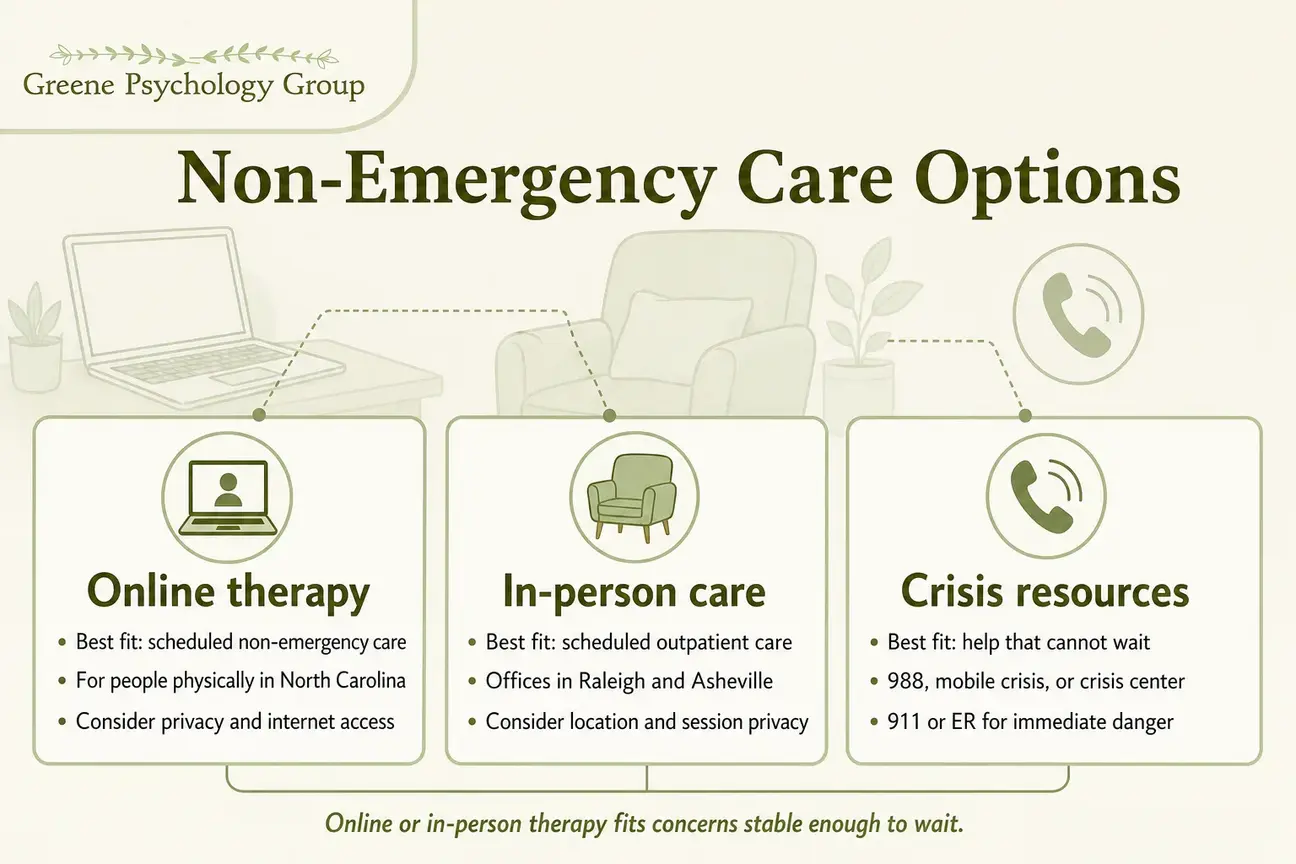
Online therapy can be a practical option for scheduled, non-emergency outpatient care. It may be especially useful when transportation, scheduling, distance, or comfort with remote sessions affects access. It is not a substitute for 988, mobile crisis, a community crisis center, 911, or emergency medical care.
Greene Psychology Group offers online therapy in North Carolina for people physically located in the state during the session, as well as in-person care through offices in Raleigh and Asheville. If comparing online and in-person therapy, consider privacy, internet access, the session location, and whether the concern is stable enough for scheduled outpatient care.
Teletherapy still requires thoughtful planning. The client should be in a private location where speaking freely is possible, and it is appropriate to ask the practice how confidentiality, technology, and emergency planning are handled. Online therapy may be appropriate for many routine concerns, but it is not the right starting point when safety cannot wait.
For some people, mental health help begins with asking whether outpatient therapy is a good fit at all. That question can be discussed with a licensed clinician when the concern is stable enough to wait. If the issue feels urgent, the safer path is crisis support first and outpatient therapy later if appropriate.
Questions to ask before starting routine therapy
When routine care seems like the right level of support, a few practical questions can make the first contact clearer. These questions are especially useful when a person is deciding between online and in-person care, comparing insurance options, or wondering what outpatient therapy can and cannot provide.
- Does this concern seem appropriate for scheduled outpatient therapy?
- How does the practice handle urgent messages between sessions?
- What should a client do if distress worsens before the first appointment?
- What information is needed to request an appointment?
- How are privacy, consent, and parent involvement handled for adolescent therapy?
- For online therapy, what does the practice need to know about the client’s location during sessions?
These questions can help distinguish routine therapy or crisis needs without requiring a person to sort everything out alone. A practice may recommend a different level of care if scheduled outpatient therapy is not a safe fit for the immediate situation.
How to contact Greene Psychology Group for routine therapy
If the concern can safely wait for scheduled outpatient care, contact Greene Psychology Group to ask about starting therapy. When contacting the practice, share only basic contact information, a brief reason for reaching out, whether Raleigh, Asheville, or online sessions are preferred, and insurance information.
Do not send detailed health information through email or the contact form, because the practice notes that those channels are unencrypted. The practice phone number is 919-205-5339, and the email address is [email protected]. Because the site notice says phones are not working properly, use the phone and email together rather than relying on one channel alone.
Greene Psychology Group is in-network with most Blue Cross Blue Shield and Aetna plans. Other plans may be out-of-network, and self-pay is accepted. Readers should confirm benefits with their insurer and the practice. You can review insurance and payment information, and uninsured or self-pay clients receive a Good Faith Estimate under the No Surprises Act. Do not assume a specific plan is accepted or covered until it is verified.
Planning ahead can make urgent mental health care less confusing
It can be difficult to make decisions when emotions are high. If someone in a household has had periods of significant distress, planning ahead may make it easier to choose between routine therapy, 988, local same-day crisis resources, or 911. A plan does not need to be complicated.
For people with ongoing concerns, planning can also include deciding when to seek mental health help before distress becomes overwhelming. For example, a person might decide to contact a therapist if sleep has been disrupted for several weeks, if conflict is escalating at home, if work or school functioning is slipping, or if coping strategies no longer feel adequate.
For families, planning can include agreeing that safety matters more than embarrassment. A parent, partner, or caregiver does not need to perfectly assess whether a situation is “routine enough.” If the person cannot stay safe, the next step is crisis or emergency support.
Planning ahead can also clarify the 988 or therapist decision before stress is high. A routine therapy plan may include outpatient appointments, coping skills, and support from trusted people. A crisis plan focuses on what to do right away when waiting is not safe.
Key takeaways about therapy or crisis decisions
If one point stays with you, let it be this: routine therapy is for concerns that can safely wait for scheduled outpatient care. Crisis and emergency resources are for situations that need help now. The decision is not a judgment about whether someone is strong, weak, overreacting, or deserving of care. It is a safety decision.
Use routine therapy for ongoing concerns such as anxiety, depression, stress, grief, relationship strain, family issues, parenting concerns, trauma-related distress, or life transitions when there is no immediate danger. Use 988 for urgent emotional distress, a mental-health or suicidal crisis, or concern about someone else. Use 911 or the nearest emergency room for immediate danger or thoughts of harming self or others.
If unsure when to seek therapy, it is reasonable to ask a licensed clinician about outpatient care when the situation is stable enough to wait. If unsure whether someone is safe, do not wait for therapy scheduling. Use crisis or emergency resources.
Greene Psychology Group is not a crisis service. Do not wait for a routine therapy response during an emergency or mental-health crisis. For immediate danger or thoughts of harming self or others, call 911 or go to the nearest emergency room. For a mental-health or suicidal crisis, call or text 988 or use the 988 Lifeline chat.
This article is for general education and isn't a substitute for diagnosis or treatment from a licensed professional. For immediate danger, call 911 or go to the nearest emergency room. For a mental-health or suicidal crisis, call or text 988.
Frequently Asked Questions
When should I seek therapy instead of waiting it out?
Consider contacting a therapist when concerns are persistent, interfere with daily life or relationships, or feel difficult to manage with current support. A diagnosis or crisis is not required to ask about outpatient therapy.
Should I call 988 or a therapist?
Call or text 988 when there is urgent emotional distress, a mental-health or suicidal crisis, or concern about someone’s immediate safety that is not clearly a life-threatening emergency. Contact a therapist for scheduled outpatient support when the situation is not urgent and can safely wait for an appointment.
Can I call 988 for someone else?
Yes. A family member, friend, caregiver, or other concerned person can contact 988 for guidance about someone who may need crisis support. If the person is in immediate danger, call 911 or go to the nearest emergency room.
What is the difference between mobile crisis and 988?
988 is a phone, text, or chat connection with a crisis counselor. Mobile crisis is an in-person crisis response that may come to a safe location when appropriate and available. 988 may help callers think through which local resource fits the situation.
Is online therapy appropriate during a crisis?
Online therapy is for scheduled, non-emergency outpatient care. It is not a substitute for 988, mobile crisis, a community crisis center, 911, or emergency medical care when safety cannot wait.
How can I tell if my teenager needs therapy or urgent support?
For routine concerns, consider therapy when changes in mood, behavior, relationships, school, sleep, or daily functioning are persistent or hard to manage at home. If a teen may be unsafe or in immediate danger, use emergency or crisis support rather than waiting for a routine appointment.
Does Greene Psychology Group provide crisis services?
No. Greene Psychology Group provides outpatient psychotherapy for adolescents and adults. The practice does not provide emergency or crisis services, inpatient care, residential treatment, intensive outpatient programs, medication prescribing, or medication management.
Sources
- National Institute of Mental Health: Psychotherapies
- 988 Suicide & Crisis Lifeline
- North Carolina Department of Health and Human Services: Crisis Services
- North Carolina Department of Health and Human Services: Mobile Crisis Teams
- North Carolina Department of Health and Human Services: Community Crisis Centers